
How to Start a Private Label 3D Printer Filament Brand
A practical guide for entrepreneurs, Amazon sellers, distributors, retailers and 3D printing companies adding filament to an existing range. What to sell, how to specify it, what to ask a factory, how to test a sample before you commit, and the checklist to run the launch against. Written by a manufacturer, so it says what a factory can and cannot do for you.
- MATERIALS & SKUS
- SPOOLS & PACKAGING
- MOQ
- SAMPLE TESTING
- QC SPEC
- LAUNCH CHECKLIST
Nothing here is gated. The checklist at the end is the part most people copy into a project doc; the question table above it is the part they email to three factories at once.
From decision to first pallet, in eight steps.
Most private-label launches go wrong in the order the work was done, not in the work itself. Artwork gets approved before a sample has been printed; a container gets ordered before a single customer has bought a spool. This is the order that keeps the expensive decisions last.
-
Define the offer
Owned by:You
Decide who buys from you and why they would leave the brand they use now. Price, availability, colors, support, spool format, a niche nobody serves — pick the reason before you pick the polymer. A filament brand without an answer here is a fourth listing on a page that already has three.
-
Shortlist manufacturers
Owned by:You
Separate factories from trading companies first, then shortlist three to five that already run your materials in production. Do this before the spec is final, because what a factory already runs will shape what your spec can affordably say.
-
Write the spec sheet
Owned by:You, with the factory
Material, diameter and tolerance, spool format and core, net weight, color reference, moisture packaging, label and carton artwork, documents required. One page. Everything you did not write down is a decision the factory will make for you — correctly by its standards, and not necessarily by yours.
-
Order samples from normal production
Owned by:Factory
One spool per candidate material, drawn from a normal run rather than made for you. Order from more than one factory at the same time, because a spool only means something next to another spool.
-
Test the samples yourself
Owned by:You
On your own machines, in your own conditions, against the tests your customers will effectively run for you. Measure, weigh, unwind and print. This is the step that costs a fortnight and saves a container.
-
Approve the golden sample and artwork
Owned by:You
Approve a physical spool, not a photograph, and a printed label proof, not a PDF. Keep the approved spool sealed and dated. Every future run is judged against it, and a dispute without one is a conversation about memory.
-
Production and quality control
Owned by:Factory
Agree what is measured, at which point, and what happens to material that fails, before the run starts. Ask for the pre-shipment figures against your spec sheet while the goods are still in the factory, not after they have sailed.
-
Freight, customs and inbound
Owned by:You, with your forwarder
Incoterms in writing, HS code confirmed, duty and destination charges estimated, and somewhere for a pallet of filament to sit when it lands. Compare suppliers at landed cost per kilo, never at ex-works price per kilo.
Steps 4 to 6 are where a launch is won. They are also the three most often compressed to save a fortnight.
Choose materials from what you sell, not from what is cheapest to buy.
The material list is the single decision that most shapes everything downstream: minimum order, color count, packaging, support burden, return rate. Choosing it from a price list is how brands end up with pallets of something their customers were never going to buy.
-
START FROM THE BUYER
Hobbyists, print farms, schools, engineering teams and prop makers buy almost disjoint material sets. A school buys PLA and rarely anything else. A print farm buys one or two materials in volume and cares about run-to-run consistency far more than about color. An engineering buyer wants a datasheet and will pay for a filled grade.
Write down the buyer first and let the material list fall out of it. If you cannot name the customer for a SKU, that SKU is inventory rather than a product.
-
HOW MANY TO LAUNCH WITH
Two or three materials is a range. Six is a warehouse. The pull towards launching broad comes from wanting to look established, and it is paid for in cash tied up in slow SKUs and in the discounting it takes to clear them.
A workable starting shape is one volume material, one functional material and at most one specialty line, then add on evidence rather than on ambition. It is far easier to add a material to a factory that already knows you than to unwind a range that did not sell.
-
PLA IS THE VOLUME
PLA is where most consumer unit volume sits, and it is the easiest material to print, to store and to support. It is also the most aggressively priced, which means it earns you customers rather than margin.
The variants matter commercially more than the base does: PLA+ and high-speed grades sell on performance, while silk, matte, metallic, dual-color, glow and fluorescent sell on appearance and hold price far better than natural PLA. The PLA and specialty PLA range shows how a line like that is usually structured.
-
THE FUNCTIONAL TIER
This is where the margin lives, and where a brand earns a reason to exist. PETG is the workhorse — tougher than PLA, tolerant of warmth and moisture-adjacent parts, forgiving enough for a general audience. ASA is the outdoor answer, holding up under UV where ABS yellows. TPU covers everything flexible, and its buyers are loyal because so little of it feeds reliably.
If you are unsure which of these your customers actually need, the material-by-job breakdown maps jobs to materials rather than the other way round.
-
FILLED AND SPECIALTY GRADES
Carbon- and glass-filled grades — PETG-CF, PA-CF, PA-GF — carry the highest margin and the least price transparency, which is exactly what makes them attractive. They are also the hardest to source well: filled compounds need different tooling, wear dies faster, and demand a hardened nozzle at the customer's end, which becomes your support load.
A factory running filled grades properly has made a real investment. A factory that lists them without running them will quote you anyway.
-
CHECK WHAT THE FACTORY ACTUALLY RUNS
Ask which materials are in production this month, which are made to order, and which are listed but not currently running. The gap between a catalog and a production schedule is where lead times quietly double.
As a worked example: our own lines run PLA and PLA+, the specialty PLAs, PETG, PETG-CF, ASA and TPU-95A. ABS, PC and PA-CF are not in production, and we say so before a quote rather than after. That distinction — a clear no on the rest — is worth demanding from every supplier you shortlist.
PLA vs PETG vs ABS vs ASA vs TPU, from the seller's side of the counter.
Print behaviour is documented everywhere. What is not, is what each material costs you as a brand once it is sitting on a shelf: the support emails, the returns, the storage, the shelf life. Nozzle ranges below are the typical published range across the category and are no substitute for a grade-specific datasheet from your own manufacturer.
| # | Material | Who buys it, and why | What it costs you to carry |
|---|---|---|---|
| VOLUME TIER | |||
| 1 | PLA | The default for hobbyists, schools and anyone printing display parts. Prints cool — typically 190–220 °C — needs no enclosure, and is the easiest first purchase a customer makes. Sells fastest, competes hardest on price. | Low support burden and few returns, but the thinnest margin and the most crowded shelf. Softens in a hot car or a sunny window, which generates a steady trickle of complaints from customers who used it structurally. |
| 2 | PLA+ / HIGH-SPEED PLA | Buyers who have printed enough PLA to be annoyed by it: more impact resistance, better layer adhesion, higher throughput on modern machines. An easy upsell inside an audience you already have. | Almost nothing operationally. The risk is definitional — “PLA+” is a marketing name with no standard behind it, so you have to be able to state what your version actually does differently. |
| 3 | SPECIALTY PLA — SILK, MATTE, METALLIC, DUAL-COLOR, GLOW, FLUORESCENT | Bought on appearance rather than properties, by makers selling finished prints and by anyone printing something to be looked at. Holds price far better than natural PLA, and is where a small brand can look distinctive quickly. | Color consistency becomes your reputation, so it demands a tight color reference and a factory that measures against it. Abrasive fillers in some glow and metallic grades wear brass nozzles, which arrives as a support ticket. |
| FUNCTIONAL TIER | |||
| 4 | PETG | The most commonly recommended step up from PLA: tough, slightly flexible, tolerant of heat and moisture-adjacent parts, and printable without an enclosure at typically 230–250 °C. The single strongest second SKU for most brands. | Hygroscopic, so it punishes thin packaging and long shelf time — this is where your moisture spec starts to matter commercially. Stringing is the most common support email in the category. |
| 5 | ABS | Bought by people who already know why they want it: machinable, solvent-smoothable, familiar from injection moulding, and cheap to produce. Still a standing request from older and industrial audiences, at typically 240–260 °C. | The highest support burden of any common material. Warps without an enclosure, emits styrene, and generates failed-print complaints that are the customer's printer rather than your filament. Many brands now carry ASA instead and lose very little. |
| 6 | ASA | The outdoor and automotive answer — ABS-like mechanically, but UV-stable where ABS yellows and embrittles. Genuinely underserved, harder to extrude well, and therefore a place where consistency shows. | The same enclosure requirement and warping tendency as ABS, so a similar support load minus the yellowing complaints. Lower volume than PETG, but a defensible slot with a clear pitch behind it. |
| 7 | TPU (TYPICALLY 95A) | Everything flexible: gaskets, phone cases, wearables, vibration mounts, RC parts. A distinct audience that buys little else and stays loyal to a filament that feeds reliably. | Feeds badly on Bowden machines, so a share of your returns will be printer mismatch rather than material fault. Softer shore grades are worse. Very hygroscopic, and it bubbles audibly when wet — which at least makes a packaging failure obvious. |
| SPECIALIST TIER | |||
| 8 | PETG-CF AND OTHER FILLED GRADES | Engineering and functional buyers who want stiffness and dimensional stability and will pay several times the PLA price for it. The least price-transparent tier on the shelf. | Requires a hardened nozzle at the customer's end, and every customer without one becomes a support case. Needs a factory genuinely tooled for filled compounds; sourcing this badly shows up as clogging complaints against your brand. |
| 9 | PC, PA / NYLON, PA-CF | Spec-driven industrial buyers with a real application and a datasheet requirement. High value per kilo, low unit volume, and a slow technical sale. | Aggressively hygroscopic and high-temperature: they demand serious packaging, a drying story and technical support you must actually be able to give. Not a first-range material for a brand without an engineer to answer the phone. |
Every material you add multiplies into colors, diameters and spool weights. Read this table as a shortlist to cut down, not as a range to assemble.
Your first SKU list is a bet. Keep it small enough to be wrong.
A SKU is not a material. It is a material, in a color, at a diameter, at a weight, in a package — and every combination is a separate thing to forecast, store, photograph, list and eventually discount.
-
COUNT THE SKUS PROPERLY
Three materials in six colors is eighteen SKUs, not three. Add a second diameter and it is thirty-six. Add a 500 g option and it is fifty-four. Each one needs its own barcode, listing, photography, stock forecast and minimum order quantity.
Do the multiplication before the first conversation with a factory. Most first ranges shrink by half the moment somebody writes the real number down.
-
A WORKABLE STARTER RANGE
One volume material in a small color set, one functional material in three or four colors, and — only if you have a reason — one specialty line in a handful of shades. Somewhere between a dozen and twenty SKUs in total, in one diameter and one spool weight.
Narrow ranges also buy negotiating power. The same total order spread across fewer SKUs means more kilos per SKU, and kilos per SKU is the number a factory actually prices against. A full production range is what you grow into, not what you launch with.
-
CHOOSING THE COLORS
In most filament ranges black and white do the volume, with grey close behind. A first color set weighted towards unusual colors is a first color set that ends up discounted.
Start with the safe core, and let the interesting colors be the specialty line — where color is the product itself rather than a variant of something else.
-
CUSTOM COLORS
Owning a color is one of the few real advantages private label has over reselling. Ask three things: the minimum run for a non-stock color, the lead time, and how closely it can be matched to a reference.
Send a physical reference — a printed chip, a Pantone number, a sample spool — not a screenshot. Ask whether matching is judged by eye or by colorimeter against a stated ΔE, and ask what tolerance applies between runs, because the second batch is where a color brand is really tested. We publish ΔE ≤1.0 against an approved reference; whatever figure a supplier gives you, make sure there is one.
-
DIAMETER: 1.75 OR 2.85 MM
1.75 mm is the volume standard and where nearly all consumer machines sit. 2.85 mm serves a smaller, specific installed base. Carrying both doubles your SKU count for a slice of demand that in most ranges does not justify it.
Launch in one diameter. Add the second when customers ask for it by name and you can point at the orders you turned away.
-
SPOOL WEIGHT
1 kg net is the default, and the format every price comparison is made in. 500 g spools suit specialty colors and sample kits, where a full kilo is more than anyone wants of one shade. Larger 2–5 kg formats suit print farms and lower your packaging cost per kilo, but narrow the audience considerably.
Pick one to launch with. A range carrying three weights on day one is a range that will be out of stock in the wrong one.
Spools, packaging, and what is actually your brand.
This is the part of a private-label run that customers hold, photograph and review. It is also the part most likely to be decided by default, because nobody wrote it into the specification.
-
THE SPOOL
Cardboard spools are lighter, cheaper to ship and easier to dispose of, and they are increasingly expected. Plastic spools are more rigid, quieter in automated feeders and reusable. Some brands offer refill coils with no spool at all.
The dimensions matter more than the material: outer diameter, width, and above all core diameter, because automated feed systems and farm racking are built around specific sizes. Ask which spool formats are already tooled, and expect spool format, core diameter and net weight to be the three things a factory can least easily change for you.
-
WINDING
Winding is the invisible quality signal. A spool wound at inconsistent tension develops crossovers, and a crossover is a print that fails at hour nine of a twelve-hour job — the failure customers write reviews about.
Ask whether winding tension is mechanically controlled and whether spools are test-fed before packing, then verify it yourself by unwinding the last 200 g of every sample. We publish no winding specification, which is a fair thing to hold against us and against anyone else who does not.
-
MOISTURE PACKAGING
Filament absorbs water from the air and prints badly once it has. The standard is a vacuum-sealed foil bag with a desiccant sachet, and the questions worth asking are whether material is dried before extrusion, whether the bag is sealed under vacuum, and whether humidity is measured at sealing rather than assumed.
A stated figure — ours is sealed below 10% RH at pack — is worth considerably more than the word “sealed”. Ask what shelf life the packaging is rated for, because your inventory will sit longer than the factory's ever does.
-
THE LABEL
The spool label does more work than branding. It has to carry your brand and material name, diameter and net weight, the print temperature range, a batch or date code, your barcode, and whatever safety or regional marking your market requires.
Print minimums on labels are usually far lower than on printed cartons, which makes the label the cheapest place to put your identity first when budget is tight.
-
BOXES AND CARTONS
Decide three levels: the individual box — or none, since plenty of brands ship the sealed bag only — the master carton, and the pallet. Ask for the print minimum on each, because a printed retail box usually carries a far higher minimum than a printed label.
Master carton markings decide whether your goods can be received cleanly: SKU, quantity, net and gross weight, dimensions. If you sell on Amazon, ask early whether the factory can apply FNSKU labels at packing or whether you will need a prep centre, because the answer changes your landed cost per unit.
-
WHAT IS ACTUALLY YOURS
Buy your own GS1 barcode prefix instead of using a factory's numbers, register your trademark in the markets you sell in, and hold your own artwork files. A brand built on a supplier's barcodes cannot change supplier without re-listing every product and losing the review history attached to it.
The practical question to put to a manufacturer is what specifically can carry your identity: label artwork, spool color, printed cartons, your GTIN and SKU codes, inserts, bag printing, assembled multipacks and sample kits. Our own answer is set out in detail on the private label 3D printer filament manufacturing page — use it as a list of things to ask your shortlist about rather than as a spec to copy.
What actually sets your minimum order.
“What is your MOQ?” is the most common first question and the least useful one. There is rarely a single number behind it: a factory has a minimum that makes an extrusion run worth setting up, a color has a minimum that makes a compound change worth making, and printed packaging has minimums set by the printer rather than the extruder. Ask for all of them separately and the quote stops moving between emails.
If the total is larger than a first launch justifies, buying unbranded stock first is a legitimate way in. A wholesale program with published per-spool tiers lets you prove sell-through before you commit to printed packaging — ours starts at one carton of 20 spools, and private-label minimums are quoted per project.
Sourcing a supplier rather than building a brand from nothing? The OEM filament procurement guide covers the same minimums from the buying side, with the enquiry to send.
| Driver | What to ask, and what moves it |
|---|---|
| PER MATERIAL | The quantity that makes an extrusion setup worth running. Usually the largest single number, and the reason a narrow range is cheaper to launch than a broad one. |
| PER COLOR | A separate minimum for each color, because every color is a compound change and a line purge. Ask it per color, not per material — this is where a twelve-color launch quietly becomes unaffordable. |
| PER FINISHED SKU | The smallest useful quantity of one finished, labelled, boxed unit. Ask for MOQ three ways — per material, per color, per SKU — and expect three different numbers back. |
| CUSTOM COLOR MATCHING | A matched color usually carries a higher minimum than a stock color, plus a matching fee and extra lead time for approval samples. Ask whether the reference is retained for repeat runs. |
| LABEL PRINT MINIMUM | Set by the label printer rather than the extruder. Usually the lowest branding minimum available, which is why labels are the cheapest place to start putting your name on things. |
| CARTON AND BOX PRINT MINIMUM | Typically far higher than labels, and often the single line that pushes a first order out of reach. Plain cartons with a printed label is a normal and unembarrassing first-run compromise. |
| TOOLING AND SPOOL FORMAT | Custom spool moulds or non-standard core dimensions are tooling, with tooling cost and tooling lead time attached. Ask which formats are already tooled before designing around one that is not. |
| LEAD TIME | Ask for in-stock, made-to-order, custom-color and sample lead times as four separate figures. One blended number hides the one you will actually be waiting on. |
| PAYMENT TERMS | Deposit percentage, balance trigger, and what happens if pre-shipment figures miss your spec. Agree the failure case in writing before the deposit, not after it. |
| FREIGHT AND INCOTERMS | EXW, FOB, CIF and DDP are not comparable prices. Get Incoterms in writing, confirm the HS code, and compare suppliers only at landed cost per kilo. |
How much does it cost to start a filament brand?
There is no single figure, but there is a structure: four buckets that move independently. Budget them separately and the number stops being mysterious. The figures here are market illustrations rather than a quote — minimums and pricing are confirmed per project.
-
QUALIFYING SUPPLIERS
The cheapest money you will spend, and the highest-leverage. One sample spool per candidate material from each of two or three factories, digital calipers, a kitchen scale, and the time to run the measurement protocol above. All in, a few hundred dollars — and it decides where every later dollar goes.
-
FIRST INVENTORY
The unbranded route keeps this small: our wholesale program starts at one carton of 20 spools per material and color, with published per-spool tiers. A four-SKU opening line at one carton each is 80 spools — at typical wholesale filament pricing, a low four-figure sum, not five. A private-label first run is larger because minimums stack per color and per SKU, which is why it is quoted per project rather than off a rate card.
-
BRAND AND PACKAGING
The costs that surprise people. Printed labels and printed cartons carry minimums set by the printer, not the extruder — commonly hundreds to a thousand units per design. Add artwork set to the dieline, a GS1 prefix for your own barcodes (an annual registration whose price scales with how many GTINs you need), and proof rounds before anything is printed. Packaging minimums, not filament minimums, usually set a private-label brand's real entry cost.
-
LANDING IT
Freight, duty and destination charges — filament is dense, so freight is a real share of landed cost, not a rounding error. Get sea and air quoted side by side, get the Incoterm in writing, and judge the whole first order as landed cost per spool rather than ex-works price per spool. A cheap quote that lands expensive is not a cheap quote.
Cheapest credible start: a narrow unbranded range to prove sell-through, then printed packaging once volume justifies the print minimums. The launch checklist below runs in that order.
Test the sample the way your worst reviewer will.
A sample is the only evidence you get before money moves. It is worth two weeks and a few failed prints, and it is the step most often skipped by people who then spend six months explaining a bad batch to customers.
-
ASK FOR PRODUCTION SAMPLES
A sample made specially for you shows what a factory can do on its best day with someone watching. A spool pulled from a normal production run shows what your customers will get.
Ask explicitly for the second, and treat a sample that arrives perfect, unlabelled and without a batch code as an unanswered question. Sample in parallel from three factories — one spool only means something next to another spool.
-
MEASURE THE DIAMETER YOURSELF
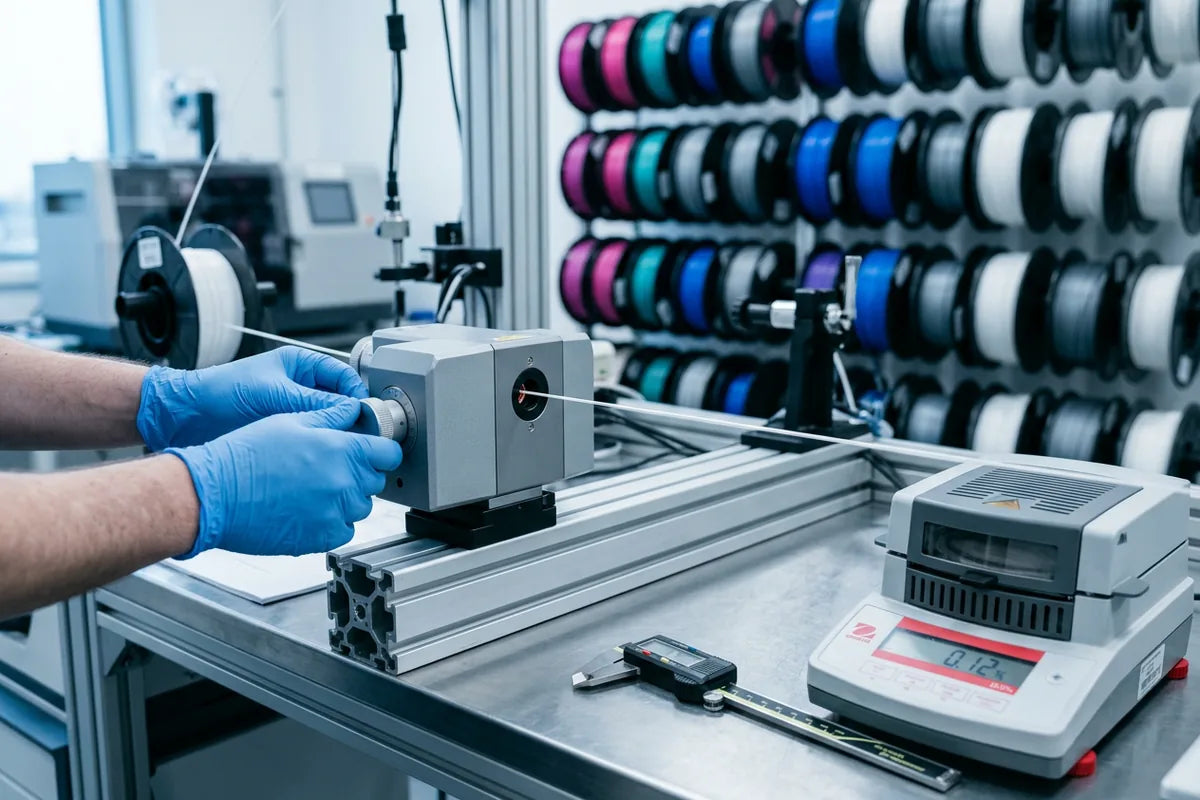
Use a micrometer rather than calipers, and measure at intervals along the strand — twenty or thirty readings a metre or so apart — recording two perpendicular axes at each point. The spread tells you the tolerance; the difference between the two axes tells you the ovality, which a single-axis figure hides completely — filament ovality and diameter tolerance, explained covers why both numbers matter.
Then compare what you measured against what was quoted. A supplier quoting ±0.02 mm, as we do, should survive that test on a spool picked at random, and so should anyone else quoting it.
-
WEIGH IT
Weigh the sealed spool, then weigh the empty spool once you have printed it out. The difference is the net weight you are actually buying.
Short weight is one of the most common and least visible ways a low price per kilo is manufactured. Ask for net weight, its tolerance and the spool tare in writing, then check the number rather than the claim.
-
UNWIND THE LAST 200 G
The end of the spool is where winding faults live. Unwind it by hand and watch for crossovers, tangles and strand-under-strand traps.
This costs ten minutes and finds the defect that otherwise shows up in a customer's twelve-hour print. Do it on every candidate factory's sample, not only the cheap one's.
-
PRINT THE TESTS THAT MATTER
A temperature tower to find the usable window, a retraction test for stringing, a dimensional cube for accuracy, a bridging or overhang test for consistency — and, the one that matters most, a print of eight hours or more, because faults invisible at ten minutes are obvious at hour nine.
Print on the machines and in the conditions your customers use, not on your best-tuned printer. Then print the same set again from a second spool of the same material, to see whether the factory is consistent or merely lucky.
-
KEEP A GOLDEN SAMPLE
When a sample passes, seal it, date it, label it with its batch code and store it. That spool is the reference for every run afterwards, and your evidence if one goes wrong.
Write the figures you measured into your spec sheet as the agreed standard and have the factory acknowledge it in writing. A quality dispute without a golden sample and a signed spec is an argument about memory, and the factory is holding the deposit.
 ±0.02 MM
The quality lines to write into your purchase order.
Quality control is not a promise, it is a list of parameters with a number and a measurement method against each one. These are the lines worth specifying in writing before a run starts. The figures shown are the ones VANYO publishes, offered as a reference point to hold a shortlist against rather than as an industry standard.
- DIAMETER
- 1.75 mm ±0.02 mm±0.05 mm is commodity, ±0.03 mm competent, ±0.02 mm tight. Ask what measures it, how often, and whether the figure is a maximum deviation or a standard deviation. Ours is an inline laser gauge reading two axes continuously during extrusion, with the line stopping automatically if either leaves ±0.02 mm.
- OVALITY
- ≤0.02 mmRound matters as much as thin. Ask for ovality as a separate number, and whether the gauge reads one axis or two — a single-axis figure cannot see an oval strand. Ours reads two, which is where our ovality number comes from.
- MOISTURE AT PACK
- Sealed below 10% RHAsk whether material is dried before extrusion, sealed under vacuum with desiccant, and whether humidity is measured at sealing or simply assumed.
- COLOR
- ΔE ≤1.0 to referenceAsk for a colorimeter reading against an approved physical reference to a stated ΔE, and ask what tolerance applies between runs rather than only within one.
- NET WEIGHT
- 1 kg per spoolAsk for net weight, its tolerance and the spool tare as three separate figures. Weigh the sample full and empty rather than trusting the number on the label.
- BATCH CONSISTENCY
- Approved sample retainedAsk what is allowed to change between runs, whether out-of-spec material is scrapped or blended back into later batches, and whether a sample from each run is retained.
- WINDING & FEED TEST
- Not publishedWe publish no winding specification and no test-feed procedure, and would rather say so than imply one. Ask your shortlist directly, then unwind the last 200 g of every sample yourself.
- PRINT TESTING
- Every batch, on our own machinesAsk whether the factory prints its own material, on which machines, how often, and what the test part checks. We test-print every batch on our own machines and check it feeds and prints cleanly. We publish no named test part, and it is a process check rather than a document — we issue no per-batch report.
- DOCUMENTS
- SDS, RoHS, REACHA safety data sheet per material, with RoHS and REACH statements on request. These are producer declarations, not third-party certifications, and a technical buyer knows the difference.
- WHAT IS NOT CLAIMED
- No ISO 9001, no CoAWe do not hold ISO 9001, do not issue certificates of analysis or per-batch test reports, and do not call our filament certified. Ask any supplier for the certificate number, issuing body and scope behind a certification claim.
Ask how each figure is measured and how often. A tolerance with no method behind it is a marketing number. Ask too what a supplier does not claim — the gaps are usually more informative than the specifications.
- SDS PER MATERIAL
- ROHS STATEMENT
- REACH STATEMENT
Questions to ask a private label filament manufacturer.
These are the private-label-specific questions — the ones about your brand, your minimums and your risk. The broader supplier-evaluation set, covering plant verification, communication, scalability and the warning signs worth walking away from, is in the full sourcing guide. Send both lists to your whole shortlist at once and compare the answers side by side rather than one at a time.
| # | Topic | Ask this | A usable answer contains |
|---|---|---|---|
| WHO YOU ARE DEALING WITH | |||
| 1 | Producer or agent | Do you own the extrusion lines that will run my order, and what is the plant address? | A plant address, a count of the lines running your material, and a willingness to do a live video call from the production floor rather than a meeting room. |
| 2 | Own catalog | Do you sell your own brand as well as producing for others, and off the same lines? | A straight yes or no. A factory that sells its own catalog has to live with the standard it sets; one that only does OEM has no such feedback loop. |
| 3 | Existing OEM work | Have you produced private-label filament before, and how can that be verified? | An offer to verify privately — sample lots, test reports, references, a line audit under NDA. Named customers in public marketing usually mean broken confidentiality rather than credibility. |
| THE FILAMENT | |||
| 4 | In production today | Which materials are running this month, which are made to order, and which are listed but not running? | A short honest list and a clear no on the rest. A catalog that never says no is a trading company's catalog. |
| 5 | Tolerance method | How is your diameter tolerance measured, how often, and is it a maximum or a standard deviation? | Continuous inline laser measurement during extrusion, with a stated action for out-of-spec material. “Strict quality control” is not an answer. |
| 6 | Failed material | What happens to material that fails inspection — is it scrapped, or blended back into later runs? | Scrapped. Reworking failed material into later batches is where run-to-run inconsistency is manufactured. |
| 7 | Moisture control | Is material dried before extrusion, and is humidity measured at sealing? | A drying schedule per material, vacuum sealing with desiccant, and a measured RH figure at pack rather than the word “sealed”. |
| YOUR BRAND | |||
| 8 | What is customisable | What exactly can carry my brand, and what is fixed by your tooling? | A specific list — label, spool color, cartons, GTIN, inserts, multipacks — and an honest statement that spool format, core diameter and net weight are usually fixed. |
| 9 | Color matching | Can you match a physical reference, judged how, and to what number? | A colorimeter, a stated ΔE against an approved reference, a matching fee and lead time, and confirmation that the reference is kept for repeat runs. |
| 10 | Artwork and proofs | What artwork formats do you need, and will I get a physical printed proof before the run? | Print-ready file specs, a named contact for artwork, and a physical label proof applied to a real spool — not a PDF mock-up — before production starts. |
| 11 | Retail and Amazon prep | Can you apply FNSKU or retail barcodes at packing, and mark master cartons to my format? | A yes or a no, not a maybe. The answer decides whether you need a prep centre, and that changes your landed cost per unit. |
| COMMERCIALS AND RISK | |||
| 12 | MOQ, three ways | What is the minimum per material, per color, and per finished SKU? | Three separate numbers, with the print minimums for labels and cartons quoted separately again. |
| 13 | Lead times | What are your in-stock, made-to-order, custom-color and sample lead times? | Four separate figures, plus what happens to them in Q4 and around factory holidays. |
| 14 | Exclusivity | Is any color, formulation or territory exclusive to me, and for how long? | A clear scope and duration in writing, or a clear no. An implied exclusivity is not one. |
| 15 | Defective lots | What happens if a run misses the agreed spec after it has shipped? | A written remedy — replacement, credit or rework — agreed before the deposit. A supplier who will not put this in writing has told you something. |
| 16 | Repeat runs | How is the same color reproduced six months from now? | A retained reference, a retained sample and a named process. This question separates a production plan from a lucky first run. |
Common private label filament mistakes.
Almost none of these are technical. They are sequencing and commitment errors — decisions made in the wrong order, or at the wrong size, before the evidence existed to make them.
-
LAUNCHING TOO MANY SKUS
The most expensive mistake in the category and the easiest to make, because a broad range feels like a real brand. It is paid for in cash tied up in colors nobody ordered.
Every SKU you add divides the same order across more variants, which raises your per-SKU cost and weakens your negotiating position at the same time.
-
BUYING ON PRICE PER KILO
Ex-works price per kilo is not a price. Short net weight, heavy spools counted as gross, thin packaging, blended-back material and unfavourable Incoterms all live in the gap between that number and what you actually pay.
Compare only landed cost per kilo of filament, net of spool, delivered to your door.
-
SKIPPING THE SAMPLE TEST
Approving a supplier on a photograph, a video call and a good conversation is common, and reliably expensive.
Two weeks of testing costs less than one bad container, and far less than the reviews a bad container earns a new brand with no history to absorb them.
-
APPROVING ARTWORK FROM A PDF
Color on a screen is not color on a printed label, and a die-cut looks different wrapped around a spool than it does flat on a page.
Ask for a physical printed proof applied to an actual spool. It costs a few days and prevents a full run of labels you dislike.
-
NO GOLDEN SAMPLE, NO SPEC SHEET
Without an approved retained spool and a written specification, a quality complaint is one memory against another — and the factory's memory is the one holding your deposit.
Seal the approved sample, date it, record its batch, and have the spec acknowledged in writing before production starts.
-
USING THE FACTORY'S BARCODES
A brand listed under a supplier's GTINs cannot change supplier without re-listing every product and losing the review history attached to them.
Buy your own GS1 prefix and register your trademark in the markets you sell in. It is cheap early and painful later.
-
ORDERING A CONTAINER FIRST
Volume pricing is real, and so is a garage full of a color that does not sell. A first order should be sized to prove demand, not to win the best price per kilo.
If the branded minimum is larger than that, start unbranded. Proving sell-through on stock spools before committing to printed packaging is a normal and unembarrassing route in.
-
IGNORING MOISTURE AND SHELF LIFE
Filament sitting in a warehouse absorbs water, and PETG, TPU and nylon absorb it fastest. A customer who receives a wet spool blames your brand, not your storage.
Specify sealing with a measured humidity figure, ask what shelf life the packaging is rated for, and rotate stock rather than stacking it.
-
TREATING THE SECOND RUN AS AUTOMATIC
The first run is watched. The second is where color drifts, tolerance loosens and a substituted resin quietly appears.
Check run two against your golden sample as carefully as you checked run one, and keep checking. Consistency is the only thing a filament brand is really selling.
A simple private label filament launch checklist.
Twenty steps in the order they should happen. Nothing here is gated and nothing needs a tool — copy it into whatever you plan in and work down it.
| # | Step | What to do | Done when |
|---|---|---|---|
| DEFINE | |||
| 1 | Name the buyer | Write down who buys from you, and why they would leave the brand they use now. | You can state the reason in one sentence without using the word “quality”. |
| 2 | Pick the materials | Choose one volume material, one functional material, and at most one specialty line. | Every material on the list has a named customer type behind it. |
| 3 | Count the SKUs | Multiply materials × colors × diameters × spool weights and write down the real number. | The total is around twenty or fewer, in one diameter and one spool weight. |
| 4 | Set the budget | Decide total first-order spend including tooling, artwork, freight, duty and barcode registration. | The figure is a landed cost, and it includes packaging print minimums as well as filament. |
| SOURCE | |||
| 5 | Shortlist factories | Find three to five manufacturers already running your materials in production. | Each has confirmed a plant address and which materials are running this month. |
| 6 | Separate producers from agents | Ask for a live video call from the production floor, and licences in the factory's own name. | You have seen the line, not a meeting room. |
| 7 | Issue one spec sheet | Send the same one-page specification to every shortlisted factory. | Every quote you receive is priced against identical requirements. |
| 8 | Work the question list | Put the question table above to each factory and record the answers side by side. | You have written answers — not verbal reassurance — on tolerance method, MOQ and defective-lot remedy. |
| SAMPLE | |||
| 9 | Order production samples | One spool per candidate material from every shortlisted factory, drawn from a normal run. | Samples arrive labelled with a batch code. |
| 10 | Measure and weigh | Micrometer readings on two axes along the strand; weigh the spool full and empty. | Measured tolerance, ovality and net weight match what was quoted. |
| 11 | Unwind the last 200 g | Hand-unwind the tail of each spool, looking for crossovers, tangles and trapped strands. | No crossovers on any candidate still under consideration. |
| 12 | Print the test set | Temperature tower, retraction test, dimensional cube, and one print of eight hours or more. | The long print completed twice, from two different spools, on a customer-representative machine. |
| 13 | Choose the factory | Decide on the evidence, then agree the written remedy for a lot that misses spec. | The defective-lot remedy is in writing before any deposit is paid. |
| PRE-PRODUCTION | |||
| 14 | Approve the golden sample | Seal, date and store the approved spool together with its batch code. | The reference sample is in a drawer, not in somebody's memory. |
| 15 | Approve artwork physically | Get a printed label proof applied to a real spool, plus the carton markings. | You have held the printed label rather than viewed a PDF of it. |
| 16 | Own your identity | Buy your own GS1 barcode prefix, register the trademark, hold the artwork files. | Barcodes, trademark and artwork are in your name, not the factory's. |
| PRODUCE & SHIP | |||
| 17 | Agree the QC lines | Diameter, ovality, moisture, color, net weight, and what happens to failed material. | Every line in the purchase order has a number and a measurement method beside it. |
| 18 | Check before it sails | Ask for pre-shipment figures against your spec while goods are still in the factory. | You hold the figures, and any deviation was resolved before dispatch. |
| 19 | Fix the freight terms | Incoterms in writing, HS code confirmed, duty and destination charges estimated. | You know your landed cost per kilo, not just your ex-works price. |
| LAUNCH | |||
| 20 | Plan the second run | Set the reorder trigger and the check against your golden sample before you need either. | Run two is scheduled to be measured as carefully as run one was. |
Steps 9 to 13 are the ones worth protecting when the timeline gets compressed. Everything after them is easier to fix than a production run that was never tested.
Starting a filament brand, answered.
How much does it cost to start a private label filament brand?
There is no single figure, because the cost is assembled from parts that move independently: the filament itself, the minimum run per material and per color, label and carton print minimums, any tooling, artwork, your own barcode registration, freight, duty and destination charges. A narrow range in one diameter with printed labels on plain cartons is the cheapest credible start; a broad range with matched colors and printed retail boxes is a different order of magnitude.
As an illustration of the shape: qualifying two or three factories with samples and measuring tools is a few hundred dollars; an unbranded four-SKU first order at one carton per SKU is a low four-figure sum at typical wholesale pricing; printed labels, cartons and barcode registration add print minimums on top; then freight and duty land it. The budget section above breaks the four buckets down.
Price it as landed cost across the whole first order rather than as a price per spool, and ask for packaging minimums separately from filament minimums.
Once you are comparing real factories, the 2026 sourcing guide has the measurement protocol and the question set to compare them with.
What is the minimum order quantity for private label filament?
It is never one number. A factory has a minimum that makes an extrusion run worth setting up, each color has a minimum that makes a compound change worth making, and printed packaging carries minimums set by the printer rather than the extruder. Ask for all of them separately.
Our own private-label minimum is quoted per project for exactly that reason. If you would rather prove demand before committing to printed packaging, the wholesale program starts at one carton of 20 spools.
Which materials should I launch with?
Two or three. One volume material — usually PLA — one functional material such as PETG, and at most one specialty line if you have a specific reason for it. Adding a material later is straightforward; unwinding a range that did not sell is not.
Can I get my own custom colors?
Usually yes, and it is one of the clearest advantages private label has over reselling. Expect a higher minimum than a stock color, a matching fee, and extra lead time for approval samples. Send a physical reference rather than a screenshot, and ask whether matching is judged by eye or by colorimeter to a stated ΔE — we publish ΔE ≤1.0 against an approved reference. Ask as well whether the reference is retained for repeat runs, because the second batch is where a color brand is really tested.
Should I use cardboard or plastic spools?
Cardboard is lighter, cheaper to ship and increasingly expected on environmental grounds; plastic is more rigid, quieter in automated feeders and reusable. The more consequential questions are dimensional — outer diameter, width and core diameter — because automated feed systems and print-farm racking are built around specific sizes. Ask which spool formats a factory already has tooled before designing around one it does not.
How do I test a filament sample properly?
Measure the diameter with a micrometer on two perpendicular axes at twenty or thirty points along the strand; weigh the spool full and then empty to confirm net weight; hand-unwind the last 200 g looking for crossovers; then print a temperature tower, a retraction test, a dimensional cube and at least one print of eight hours or more on a machine representative of your customers'. Repeat the print tests from a second spool of the same material to see whether the result is consistency or luck.
What quality documents can a filament manufacturer actually provide?
A safety data sheet per material is standard, and RoHS and REACH statements are commonly available — as ours are. Those are producer declarations, not third-party certifications, and the distinction matters the first time a customer asks. Certificates of analysis, per-batch test reports, lot traceability and ISO 9001 are separate things a supplier either holds or does not. We do not, and we say so. Where a supplier claims a certification, ask for the certificate number, the issuing body and the scope it covers.
Do I need my own barcodes?
Yes, if you intend to be a brand rather than a reseller of somebody else's stock. Buy your own GS1 prefix so the GTINs belong to you, register your trademark in the markets you sell in, and keep the artwork files. A range listed under a factory's barcodes cannot change factory without re-listing every product and losing the reviews attached to those listings.
How long does a private label filament run take?
Ask for the components separately — sample turnaround, artwork and proofing, production, and freight transit — because a single blended figure hides the one that will actually delay you. Custom colors add an approval loop, printed cartons add a print lead time, and factory holidays move everything. Our own lead times are confirmed with the quote for that reason.
Is it better to start with private label or with wholesale?
Wholesale is lower risk and lower ceiling: you buy stock spools, prove you can sell filament, and keep your capital moving. Private label costs more up front and is the only route to a brand you own, a color nobody else has, and a margin that is not set by a price comparison against identical spools.
A common sequence is to do both — start on the wholesale program to prove sell-through, then move the proven SKUs to private label manufacturing once you know which ones they are.
Planning a private-label filament line? Start with a spool, not a container.
SAMPLES
- One 1 kg spool per candidate material
- At carton pricing
- Credited against your first carton
- Tested on your machines, not ours
YOUR REQUIREMENTS
- Materials, colors and volume
- Spool format and packaging
- What needs to carry your brand
- Destination and Incoterms
WHAT WE PUBLISH
- 1.75 mm at ±0.02 mm, ovality ≤0.02 mm
- Sealed below 10% RH at pack
- ΔE ≤1.0 to approved reference
- SDS, RoHS and REACH statements