
How to Choose a 3D Printer Filament Manufacturer
A buyer's guide for distributors, filament brands, wholesalers, Amazon sellers, retailers and private-label buyers. Twenty-two criteria to evaluate a supplier against, the question that gets a straight answer on each one, and the warning signs worth walking away from. Written by a manufacturer, so it states what we do not claim as clearly as what we do.
- 22 CRITERIA
- QUESTIONS TO ASK
- WARNING SIGNS
- SCORING CHECKLIST
Nothing here is gated. The checklist is the part most buyers copy straight into an email to three suppliers at once.
Establish who is actually on the other end.
Nothing further down this page can be verified while the first question is open. A supplier who cannot change what happens on the extruder cannot fix a tolerance problem, cannot run your color, and cannot tell you why the third lot printed differently from the first.
-
MANUFACTURER OR TRADING COMPANY
A manufacturer owns the extrusion lines and can change what happens on them. A trading company buys finished spools and puts your label on someone else's run — it can quote anything and fix nothing.
Ask for the plant address, how many lines run your material, and a live video call from the production floor rather than a meeting room. Ask which materials they extrude themselves and which they buy in; most factories do both, and the honest ones say which is which. A business licence and an export licence in the factory's own name are documents an agent will struggle to produce.
-
QUALITY-CONTROL PROCESS
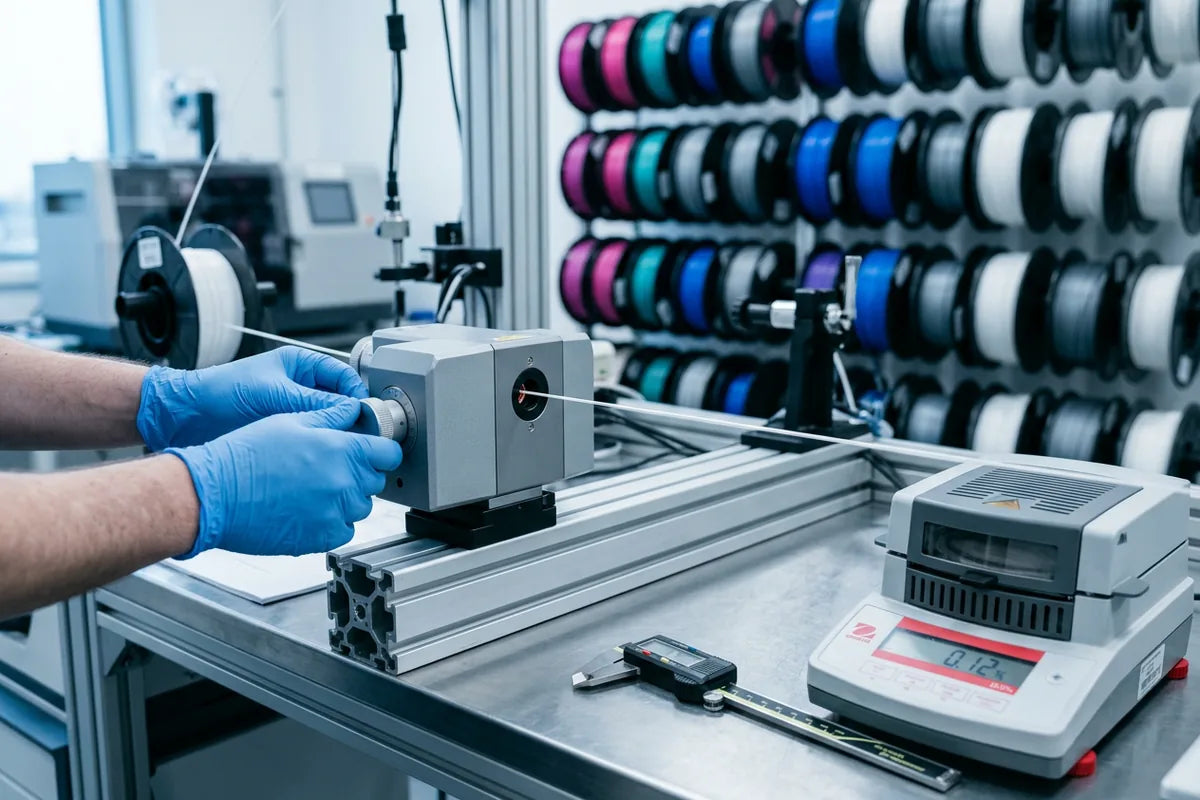
Ask what is measured, at which point in the process, and what happens to material that fails. The answer you want names instruments and positions: an inline laser micrometer during extrusion, moisture at sealing, color against an approved reference before boxing.
“We have strict quality control” is not an answer. “Diameter is sampled continuously on the line and out-of-spec material is scrapped, not blended back in” is. Ask that last part explicitly — reworking failed material into later runs is where batch inconsistency is manufactured.
-
COMMUNICATION
Time a reply before you place an order. What you get while they are winning your business is the best it will ever be.
Ask a technical question that needs the production floor to answer — the drying schedule for their PETG, the ovality spec, what changes between color runs — and see whether the reply comes from someone with access to the line or from a sales inbox. Check the working-hours overlap and whether one named person owns your account. A supplier who goes quiet for four days during qualification will go quiet for four days during a claim.
-
PRODUCTION SCALABILITY
A supplier who can deliver 500 spools and one who can deliver 20,000 look identical on a first order. Ask what one line produces per day, how many lines run your material, and what those lines are doing in Q4.
Then ask what happens when your forecast doubles: more shifts, more lines, or a longer queue behind other customers. And ask how a repeat order of the same color six months out is handled — that question separates a production plan from a lucky first run.
What has to be true of the filament itself.
Nine specifications decide whether the tenth spool prints like the first. Ask for each of them as a number with a method attached — a number without a method is a marketing figure, and every supplier has one.
-
MATERIAL SELECTION
Match the catalog to what you actually sell, not to the longest list. A supplier who lists thirty materials and runs four will quote you all thirty.
Ask which materials are in production today, which are made to order, and which are listed but not running. Filled grades need different tooling and wear dies faster, so a factory running them properly has made a real investment. If you sell to functional printers, look at PETG, ASA and TPU alongside PLA; if you are not sure what a job needs, start from the material-by-job breakdown.
-
DIAMETER TOLERANCE
The headline number, and the one most often quoted without a method. ±0.05 mm is commodity, ±0.03 mm is competent, ±0.02 mm is tight — but the figure means nothing until three follow-ups are answered: measured with what, how often, and is it a maximum deviation or a standard deviation?
Continuous inline laser measurement during extrusion is the answer you want. Calipers on a few spools at the end of a run is a different claim wearing the same number.
-
ROUNDNESS
Filament can hold diameter on one axis and be oval on the other. An oval strand measures in spec, then under-extrudes on one side and slips in an automated changer.
Ask for ovality as a separate figure from diameter — ≤0.02 mm is a tight spec — and ask whether the micrometer measures on two axes or one. Single-axis measurement cannot detect ovality at all, so a supplier who cannot answer this is probably not measuring it. What both figures mean — and the ten-minute caliper check that verifies them — is set out in filament ovality and diameter tolerance, explained.
-
MOISTURE CONTROL
PETG, TPU, PA and PC pull water out of the air, and wet filament prints badly weeks after the customer bought it — which arrives as your return, not the factory's.
Ask three things: is material dried before extrusion, is it vacuum-sealed at pack, and is there a measured moisture figure at sealing rather than a desiccant sachet in the bag. A specified figure is a control. A sachet is packaging.
-
COLOR CONSISTENCY
Your customer buys the same color eight months later and expects it to match. Ask how color is verified: by eye, or with a colorimeter against an approved reference, to a stated ΔE.
ΔE ≤1.0 against an approved reference is a real control. “We use the same masterbatch” is not, because masterbatch lots drift. Ask what happens to a run that misses the reference, and keep an approved retained sample of every color you sell.
-
BATCH CONSISTENCY
Anyone can produce one good spool. The question is whether spool 2,000 matches spool 1.
Ask what is allowed to change between runs — resin supplier, masterbatch lot, line, operator — and what is held constant. Ask whether the factory retains a sample of each run, and whether spools carry a lot marking you can quote in a complaint. Plenty of suppliers do not operate lot traceability, and it is far better to know that before four spools come back printing differently from the rest.
-
SPOOL WINDING
The failure your customers report as “the filament snapped” is usually a tangle from crossed winding, and it shows up in the last third of the spool — long after your return window felt generous.
Ask whether winding is mechanical or by hand, whether tension is controlled, and whether spools are test-fed. On a sample, unwind the last 200 g yourself; that is where crossovers live. Check the filament end is secured in a hole or clip rather than left loose in the box.
-
NET WEIGHT
Net weight is filament only, excluding the spool. Short-filling is the quietest way to cut cost per spool, and it is the first thing a customer with a kitchen scale checks.
Ask for the net figure, the tolerance on it, and the spool tare so the number can be verified. Then weigh your samples. A 1 kg spool that arrives with 940 g of filament is a 6% price increase disguised as a competitive quote.
-
PRINT TESTING
Ask whether the factory prints its own material, on which machines, and what the test part is checking. A print catches what no micrometer sees: layer adhesion, stringing, warping, a color that prints darker than the pellet looked.
Ask whether printing happens per production run or occasionally, and ask to see the test part and its result. If the honest answer is that printing happens when a customer complains, treat every other figure as unverified in practice.
What arrives, whose name is on it, and on what terms.
The filament can be right and the deal still wrong. These nine decide whether the product is sellable in your channel, at your margin, on a schedule your customers will accept.
-
PACKAGING
Packaging is a cost line and a return-rate line at once. Ask what a spool ships in: vacuum bag, individual carton, master carton count, and how the master carton is marked so a warehouse or 3PL can receive against it.
If you sell on a marketplace, ask whether cartons can be printed and labelled to your requirements and whether spools can be packed in the multipacks you actually list. Ask for a transit-damage rate if they track one.
-
CUSTOM COLORS
A producer can run a color you specify; a reseller can only sell you what already exists. Ask the minimum run per color, the lead time, whether matching is done against a physical reference or a numbered system, and what matching tolerance they will commit to in writing.
Be precise about what a color match means to them. Filament color reads differently by material, gloss and layer geometry, so a match agreed against a printed part is worth more than one agreed against a paper chip. Approve a physical sample before the run.
-
OEM CAPABILITIES
OEM means the run is built to your specification rather than picked off theirs — your material, color, diameter, spool and packaging. Ask what is genuinely variable and what is fixed by their tooling.
Spool format, core diameter and net weight are the three that most often turn out to be fixed. If your customers feed automated changers, core and outer dimensions matter as much as the filament does.
The whole procurement sequence — OEM vs private label vs wholesale, MOQ drivers, custom colors and packaging — is set out separately.
-
PRIVATE LABELING
Ask what can carry your brand: spool label, spool color, printed carton, master carton markings, inserts, bag print, and your own GTIN and SKU so stock arrives scan-ready instead of needing a relabel.
Ask who sets artwork to the dieline, how many proof rounds are included, and what the print minimums are — labels and boxes carry minimums independent of the filament, and they usually set the real MOQ. Our own private-label and OEM manufacturing page lists what a run can be specified down to, if you want a reference for what to ask other suppliers. If you are building the brand from scratch rather than sourcing for one that exists, start with how to start a private label filament brand, which covers SKUs, colors, packaging and the launch order.
-
MOQ
Ask for the minimum three ways: per material, per color, and per SKU. They are rarely the same number, and the one that hurts is per color.
A supplier quoting one global MOQ has usually not costed the packaging minimums underneath it. Ask what the MOQ would be unbranded versus under your label. Starting unbranded is how most buyers qualify a factory without committing to printed packaging on day one.
-
SAMPLING
Never skip this, and never accept a sample the supplier printed. Ask for one spool per candidate material and print it on your own machines with your own profiles.
Ask whether sample cost is credited against a first order, how long a sample takes, and — the question that matters — whether it comes from normal production or from a run made specially for you. A hand-picked sample shows what the factory can do on its best day, not what it does on a Tuesday.
-
LEAD TIMES
Ask for three separate numbers: in-stock dispatch, made-to-order production, and custom color or custom packaging. Then ask what those numbers were during the last peak season rather than what they are this week.
Ask what happens when a run misses its date, and whether you hear about it before the ship date or after. For sea freight, get production time and transit time quoted separately so a delay can be attributed to one of them.
-
DOCUMENTATION & CERTIFICATIONS
Know the difference between a producer statement and a third-party certification, because a supplier hoping you will not is a supplier to watch closely.
An SDS, a RoHS statement and a REACH statement are self-declared documents a producer issues. ISO 9001 is held by an accredited body and carries a certificate number and a scope you can verify. A certificate of analysis is a per-batch test report, which requires per-batch testing and lot records behind it. Ask for the documents themselves rather than the claim — and check whose name is on them, because some are held by a trading partner rather than the factory.
-
SHIPPING & EXPORT
Get Incoterms in writing. EXW, FOB and DDP put freight, duty and customs risk in very different places, and confirm who is exporter of record.
Ask about HS code and origin declarations, whether the factory has shipped to your country before, and which documents travel with the goods. Filament is dense and heavy, so freight is a real share of landed cost: get sea and air quoted side by side and compare suppliers at landed cost per kilo, not ex-works cost per spool.
Filament manufacturer evaluation checklist.
Twenty-two rows in four groups. Send columns two and three to three suppliers at the same time and compare the replies rather than the websites — the differences show up inside a day.
Score each row pass, partial or fail, and treat a row nobody can answer as a fail rather than a maybe. A supplier who answers eighteen of twenty-two and says plainly which four they cannot is a safer bet than one who answers all twenty-two without a number in sight.
| # | Criterion | What to ask | What a usable answer contains |
|---|---|---|---|
| THE SUPPLIER | |||
| 1 | MANUFACTURER OR AGENT | Who owns the extrusion lines, where is the plant, and can we walk it on a live call? | A plant address, a line count, a floor walkthrough on video, and licences in the factory's own name. |
| 2 | QUALITY-CONTROL PROCESS | What is measured, at which point in the process, and what happens to material that fails? | Named instruments and positions. Out-of-spec material scrapped, not blended back into later runs. |
| 3 | COMMUNICATION | Who owns our account, and what is the response time on a question only the floor can answer? | A named person with access to production, and a reply inside one business day. |
| 4 | PRODUCTION SCALABILITY | What does one line produce per day, how many lines run our material, and what if our forecast doubles? | Output per line, line count, and a stated route to more volume rather than a reassurance. |
| THE FILAMENT | |||
| 5 | MATERIAL SELECTION | Which materials are in production today, and which are listed but not currently running? | A short list they will stand behind, and an explicit no on anything they do not run. |
| 6 | DIAMETER TOLERANCE | What is the tolerance, measured with what, how often, and is it maximum deviation or standard deviation? | A figure with a method: continuous inline laser measurement during extrusion. |
| 7 | ROUNDNESS | What is the ovality spec, and does the micrometer measure one axis or two? | Ovality quoted separately from diameter, from two-axis measurement. |
| 8 | MOISTURE CONTROL | Is material dried before extrusion, vacuum-sealed at pack, and measured at sealing? | A measured moisture figure at sealing, not a desiccant sachet offered as the control. |
| 9 | COLOR CONSISTENCY | How is color verified, against what reference, and to what ΔE? | A colorimeter, an approved retained reference, and a stated ΔE. |
| 10 | BATCH CONSISTENCY | What is allowed to change between runs, and is a sample of each run retained? | A named list of what is held constant, retained samples, and a lot marking you can quote. |
| 11 | SPOOL WINDING | Is winding mechanical with controlled tension, and are spools test-fed before packing? | Controlled tension, a test-feed step, and a filament end secured in a hole or clip. |
| 12 | NET WEIGHT | What is net filament weight, what is the tolerance on it, and what is the spool tare? | Three numbers you can verify on a scale in ten minutes. |
| 13 | PRINT TESTING | Do you print your own material, on which machines, per production run or occasionally? | A named test part, a stated frequency, and a result you are allowed to see. |
| PACKAGING & BRAND | |||
| 14 | PACKAGING | What does a spool ship in, and how is the master carton marked? | Bag, carton, master carton count and markings a warehouse or 3PL can receive against. |
| 15 | CUSTOM COLORS | Minimum run per color, lead time, and what matching tolerance will you commit to in writing? | A minimum, a lead time, and a physical sample to approve before the run. |
| 16 | OEM CAPABILITIES | What is genuinely variable — spool format, core diameter, net weight, filament diameter? | A clear split between what we can specify and what their tooling fixes. |
| 17 | PRIVATE LABELING | What can carry our brand, and what are the print minimums on labels and cartons? | An itemised list, the number of proof rounds included, and print minimums stated separately. |
| COMMERCIAL | |||
| 18 | MOQ | What is the minimum per material, per color and per SKU — branded and unbranded? | Three numbers rather than one, and a lower unbranded route to qualify on. |
| 19 | SAMPLING | Is the sample from normal production, is the cost credited, and how long does it take? | A production sample, credited against the first order, with a stated turnaround. |
| 20 | LEAD TIMES | In-stock, made-to-order and custom — three numbers, and what were they in peak season? | Production and transit quoted separately, plus a stated policy for a slipped date. |
| 21 | DOCUMENTATION | Which documents exist today, and whose name and scope are on them? | The actual files. A certificate number and scope for anything described as certified. |
| 22 | SHIPPING & EXPORT | Which Incoterm, who is exporter of record, and what is the landed cost per kilo? | Incoterms in writing, sea and air quoted side by side, and the HS code confirmed. |
Nothing on this list is proprietary. It is the same list we expect to be handed, and the sections below say how we answer it.
Nine things that should slow a deal down.
None of these is proof of a bad supplier on its own. Two of them together, in the same conversation, usually is.
-
A PRICE BEFORE A SPEC
A quote that lands before anyone asked your material, volume, destination or packaging is a price for something unspecified. It will move once the spec exists, and it will not move down.
-
TOLERANCE WITHOUT A METHOD
±0.02 mm is a strong figure and an easy one to type. If nobody can say what measures it, how often, and what happens to material that misses, the number is decoration.
-
A CATALOG THAT NEVER SAYS NO
Every material, every filled grade, every diameter, always in stock. Real lines have limits. A supplier who will not name theirs is quoting from somebody else's factory.
-
CERTIFIED, UNSPECIFIED
“Certified”, “industrial grade” or “ISO standard” with no certificate number, no issuing body and no scope. Ask for the certificate, then check the name on it is the factory's.
-
A FACTORY YOU CANNOT SEE
Photographs that reverse-image search to somewhere else, and a refusal to walk the floor on a live call. A producer will show you extruders. An agent will show you a catalog.
-
A SAMPLE THAT ARRIVES PERFECT AND UNLABELLED
No lot marking, no spec sheet, no production packaging. It may be excellent, and it may not be what production ships. Ask for a spool pulled from a normal run.
-
NET WEIGHT THAT IS NOT NET
Gross weight quoted as net, or no tolerance offered on it at all. Weigh every sample. A six per cent short-fill is the quietest price rise in this industry.
-
EVERY ANSWER FROM SALES
Technical questions routed through one account manager, answers arriving days later and vague. It usually means nobody with access to the line is in the conversation.
-
TERMS THAT MOVE
MOQ, price or lead time changing between emails, or pressure to pay a deposit before the sample and the spec are signed off. Get the agreed spec in writing before money moves.
 Ø 1.75 ±0.02 mm
What we publish, and what we do not.
We are the producer, so these checks happen on our own line before spools are labelled and boxed rather than at an agent's warehouse after the fact. Two rows below are things we do not do. They are here because a guide that lists only a supplier's strengths is an advertisement.
- DIAMETER
- 1.75 ±0.02 mmAn inline laser gauge reads the strand on two axes continuously during extrusion, and the line stops automatically if either axis leaves ±0.02 mm — so out-of-spec material is caught on the line rather than found later in a spool.
- OVALITY
- ≤0.02 mmRead off the same two-axis laser measurement as diameter, which is what makes it a number rather than an assumption. Quoted separately so filament feeds round through a Bowden tube and through an automated changer, not only through a straight path.
- MOISTURE
- <10% RH sealedVacuum-sealed at pack. Wet PETG and TPU print badly weeks after purchase, and that arrives as your return, not ours.
- COLOR
- ΔE ≤1.0Against the approved reference, so the second run of a color matches the one your customers already bought.
- NET WEIGHT
- 1 kgNet filament weight per spool across the catalog, excluding spool tare. Weigh a sample and check us.
- MATERIALS
- 7 familiesPLA, PLA+, PLA specialty, PETG, PETG-CF, ASA and TPU-95A are in production. ABS, PC and PA-CF are not — ask before quoting them to a customer.
- PRINT TEST
- Every batch, on our own machinesEvery batch is test-printed on our own machines and checked that it feeds and prints cleanly before it ships. We do not publish a named test part, and this is a process check rather than a document — we issue no per-batch report.
- DOCUMENTATION
- SDS · RoHS · REACHAvailable per material. These are producer statements, not third-party certifications: we do not hold ISO 9001 and we do not describe our filament as certified.
- WINDING
- Not publishedWe publish no winding or tangle specification. Criterion 11 above is one to put to us directly — and to check yourself, on the last 200 g of a sample spool.
- LOT RECORDS
- Not in placeWe do not issue certificates of analysis, per-batch test reports or per-spool lot traceability today. If your customer requires them, say so early rather than after your packaging is printed.
Documentation available per material: SDS, RoHS statement and REACH statement. Ask for the files themselves — that is what this guide tells everyone else to do.
- SDS · EVERY MATERIAL
- ROHS STATEMENT
- REACH STATEMENT
How we answer the commercial half.
The same list, answered for VANYO. We manufacture — our own extrusion lines, in China — and sell our own catalog off them, which is why the specifications above and the terms below come from the same place. We have also produced filament for established brands in the industry. Those agreements do not let us name them publicly, but we will verify the relationship privately under NDA: sample lots, test reports, references, or a line audit.
If the run needs your brand on the spool, the detail sits on the private label and OEM manufacturing page. If you would rather qualify us unbranded first, the wholesale program starts at one carton, with published per-spool tiers, and the full range sits in all filaments.
| Criterion | Our answer |
|---|---|
| PRODUCER OR AGENT | Manufacturer — our own extrusion lines in China; relationship verification offered under NDA |
| MATERIALS | PLA, PLA+, PLA specialty, PETG, PETG-CF, ASA and TPU-95A in production; ABS, PC and PA-CF are not |
| DIAMETER & SPOOL | 1.75 mm at ±0.02 mm on 1 kg spools; other diameters and spool formats on request |
| SAMPLES | One 1 kg spool per candidate material at carton pricing, credited against your first carton order |
| MOQ | Unbranded from one carton — 20 spools per material and color; private-label MOQ quoted per project |
| PRIVATE LABEL / OEM | Spool label, spool, box, inserts, bag print, your GTIN and SKU — quoted per run |
| CUSTOM COLORS | Run on our own lines; minimum run and matching tolerance quoted per color |
| LEAD TIME | Confirmed with your quote; production time and freight quoted as separate numbers |
| PAYMENT | Net-30 for approved accounts; purchase orders accepted |
| SHIPPING | Dispatch from our factory in China by sea or air; freight and Incoterms quoted per destination |
Choosing a supplier, answered.
How do I tell whether a filament supplier is a manufacturer or a trading company?
Ask three things and watch which ones get an answer: the plant address, how many extrusion lines run your material, and a live video call from the production floor rather than a meeting room. Then ask for a business licence and an export licence in the factory's own name. A trading company can forward a catalog and a price list. It cannot walk you down a line it does not own, and it cannot change a specification on one.
For the measurement side of the same decision, the 2026 private label sourcing guide carries a spool audit protocol you can run on any supplier's samples.
What diameter tolerance should I ask a filament manufacturer for?
±0.05 mm is commodity, ±0.03 mm is competent and ±0.02 mm is tight. The figure only means something with a method behind it, so ask what measures it, how often, and whether it is a maximum deviation or a standard deviation. Continuous inline laser measurement during extrusion is the answer worth paying for. Ask for ovality as a separate number as well — filament can hold diameter on one axis and still be oval on the other.
How many samples should I test before placing a bulk filament order?
One spool per candidate material is enough to decide, provided it came from normal production rather than a run made specially for you, and provided you print it on your own machines with your own profiles. Print the part you actually sell, not a benchmark cube. Unwind the last 200 g to check winding, and weigh the spool full and empty to check net weight against the quoted figure.
What documentation can a 3D printer filament manufacturer actually provide?
Most producers can issue a safety data sheet per material, plus RoHS and REACH statements. Those are self-declared producer documents and entirely legitimate to ask for. ISO 9001 is different: it is held by an accredited body and comes with a certificate number and a scope you should check, including whose name is on it. A certificate of analysis is different again — it is a per-batch test report, and it requires per-batch testing and lot records behind it. Ask for the documents themselves, not the claim.
What is a normal MOQ for private-label filament?
There is no single figure, because the minimum is usually set by the packaging rather than the filament. Printed labels and printed cartons carry print minimums independent of the material, and a custom color carries a minimum run of its own. Ask for the MOQ three ways — per material, per color and per SKU — and ask what it would be unbranded. Most buyers qualify a factory on unbranded stock first and move to their own label once the material is proven — the private-label launch guide sets out what drives each of those minimums.
How do I check net weight and spool winding on a filament sample?
Weigh the sealed spool, print or unwind the material, then weigh the empty spool. The difference is net filament weight and it should match the quoted figure inside the quoted tolerance. For winding, unwind the last 200 g by hand — crossovers sit in the bottom third of the spool, which is why tangles get reported weeks after purchase rather than on day one. Check the filament end is secured in a hole or a clip rather than left loose in the box.
How long should filament production and shipping take?
Ask for three separate numbers rather than one: in-stock dispatch, made-to-order production, and custom color or custom packaging. Then ask what those numbers were in the last peak season. Keep production time and freight time quoted separately so a delay can be attributed to one of them, and get the Incoterm in writing — EXW, FOB and DDP place freight, duty and customs risk very differently.
Is it safe to buy 3D printer filament from a manufacturer in China?
Most filament is produced in China, including a good deal of what sells under European and American brand names. Origin is not the variable that decides quality; documentation and verification are. Qualify the same way you would anywhere: confirm the factory owns its lines, get every spec with a method attached, test a production sample on your own machines, get Incoterms and exporter of record in writing, and check whose name and scope are on any certificate you are shown.
What should be agreed in writing before a private-label run starts?
Five things: the material specification, the approved physical sample, the artwork proof, the packaging specification including master carton markings, and the commercial terms — price, MOQ, lead time and Incoterms. Nothing should be scheduled for production until all five are signed off, because everything after that point is expensive to change. Our private label and OEM page sets out the sequence we run.
How do I request filament samples or a quote from Vanyo?
Use the quote form. It asks the four things that set a price: material, volume, destination, and what needs customizing. Pricing follows in one business day, and samples are one 1 kg spool per candidate material at carton pricing, credited against your first carton order. If you would rather talk it through first, contact us, or read how we produce before you ask.
Test the filament before you commit to the supplier.
SAMPLES
- One 1 kg spool per candidate material
- At carton pricing
- Credited against your first carton
- Printed on your machines, not ours
QUOTE
- Material, volume and destination
- Pricing in one business day
- MOQ quoted per project
- Freight and Incoterms per destination
QUALIFY US
- Ask for the plant, not the catalog
- Ask how ±0.02 mm is measured
- Ask what we do not claim
- Verification under NDA