
OEM 3D Printer Filament: MOQ, Custom Colors & Packaging Explained
How OEM filament procurement actually runs, written from the manufacturing side of the desk. What OEM means and how it differs from private label and wholesale, what really sets a minimum order, what can be changed in the color, the formulation, the spool, the label and the box — and the requirements-to-shipping sequence every serious run goes through.
- OEM VS PRIVATE LABEL
- MOQ DRIVERS
- CUSTOM COLORS
- COLOR MATCHING
- SPOOLS & PACKAGING
- SAMPLES & QC
Nothing here is gated. The process below is the sequence a real run follows; the checklist at the end is what to put in the first email so a factory can quote instead of asking twelve questions back.
What “OEM filament” actually means.
The term is used loosely in this category, which is the main reason quotes come back that are not comparable to each other. In filament, an OEM arrangement means a manufacturer extrudes to a specification you set and the finished goods carry your brand: you own the product, the factory owns the process.
-
THE PLAIN DEFINITION
Filament produced by a manufacturer to a specification you set, sold to you as finished goods under your own brand. The factory contributes the plant, the polymer sourcing, the process control and the packing. You contribute the specification, the artwork, the forecast and the commercial risk.
-
WHAT YOU CONTROL
Material and grade, color, diameter, the tolerance you require, spool format and net weight, moisture packaging, label and carton artwork, your own GTIN and SKU, pack configuration, and the quality lines written into the purchase order.
-
WHAT THE FACTORY CONTROLS
Polymer and masterbatch sourcing, drying, extrusion parameters, line speed, winding, in-line measurement, and what happens to material that fails it. Ask how each of these is run. Do not expect to set them.
Ask, don't assume
-
OEM VERSUS ODM
OEM: you specify, they build. ODM: they specify, you badge. Most filament sold as OEM is nearer ODM — the factory’s existing formulation in your color and your packaging. True OEM starts where the specification itself is written for you, and it carries different minimums, different lead times and a different price.
Ask which one you are being quoted
-
WHO BUYS IT
Printer manufacturers bundling material with hardware, resellers moving from stock spools to their own line, industrial users standardizing one material across sites, marketplace sellers who want a product rather than a listing, and brands whose last contract manufacturer stopped answering. Different motives, one procurement problem.
-
WHY IT IS BOUGHT DIRECT
Every layer between the extruder and your shelf adds margin and removes information. Buying from the plant means the tolerance figure, the drying schedule and the failure disposition come from the people who run them, rather than from a broker relaying an answer they cannot check. Separating the two is the subject of the supplier evaluation guide.
OEM vs private label vs wholesale.
These three get used interchangeably and they are not the same purchase. They differ in what is customized, what the minimum looks like, how long it takes and how much of the risk moves onto your balance sheet. Most buyers are better served moving through them in order than starting at the end. If you are building a brand from nothing rather than adding a supplier, the launch guide covers the same ground from the other direction.
| # | Model | What you are actually buying | When it is the right call |
|---|---|---|---|
| BUY IT AS IT IS | |||
| 1 | WHOLESALE | The factory’s own brand, on its own spools, in its own packaging, bought at volume pricing. Nothing is customized and nothing is developed. | First, almost always. It proves the material sells and the supplier ships on time before any money goes into artwork, tooling or a color minimum. |
| PUT YOUR NAME ON IT | |||
| 2 | PRIVATE LABEL | The factory’s existing product in your packaging: its formulation and its spool, your label, your box, your barcode, your SKU. | Second. The lowest-cost route to owning a shelf presence, because nothing about the filament changes and the minimums follow packaging print runs rather than extrusion runs. |
| 3 | CUSTOM COLOR / SEMI-CUSTOM | A stock formulation run in a color that is yours, in your packaging. A compound change at the hopper, not a development project. | When the color is the differentiator — a brand palette, a printer manufacturer matching its hardware, or a range that has to read as a range on a marketplace grid. |
| HAVE IT MADE FOR YOU | |||
| 4 | OEM | Filament extruded to a specification you set — material, grade, diameter, tolerance, spool format, packaging — delivered as finished goods under your brand. | When volume and specification both justify it. Minimums, lead times and tooling all step up, and so does the value of getting the sample stage right. |
| 5 | ODM / FACTORY FORMULATION | The factory’s own formulation and development work, badged as yours. Faster and cheaper than true OEM, and very frequently sold as OEM. | When you want a product quickly and have no formulation requirement of your own. Ask explicitly which of the two you are being quoted, in writing. |
| 6 | CONTRACT / TOLL MANUFACTURING | You supply the resin or the masterbatch; the factory extrudes, winds and packs it. You carry the material cost and the material risk. | Rare in filament, and only sensible when you already control a polymer supply or a proprietary compound of your own. |
| THE USUAL SEQUENCE | |||
| 7 | HOW THE THREE FIT TOGETHER | Wholesale to qualify the supplier, private label to prove the brand sells, OEM once volume and specification both justify the step up. | Almost always. Committing to an OEM run before a spool has been printed and sold is the most expensive available way to learn what your customers actually buy. |
A supplier that offers all of these without distinguishing between them is usually a trading company. Ask which lines are theirs.
Requirements → Samples → Testing → Approval → Production → QC → Shipping
Seven gates. Each one exists to catch a class of error while it is still cheap, and each one gets skipped by somebody every week to save a fortnight. This is the sequence an OEM filament run actually follows, with who owns each step — because the steps that go wrong are usually the ones nobody was named against.
-
Requirements
Owned by:You, with the factory
Material and grade, diameter and tolerance, color reference, spool format and core, net weight, moisture packaging, label and carton artwork, barcodes, pack configuration, volume, forecast and destination. One page, sent identically to every supplier you are quoting, so the prices that come back are comparable.
-
Samples
Owned by:Factory
Sample spools produced to the agreed specification — and, separately, a spool pulled from current production. The first shows what was promised; the second shows what an ordinary Tuesday looks like. Ask for both, and ask what a sample costs and whether it is credited.
-
Testing
Owned by:You
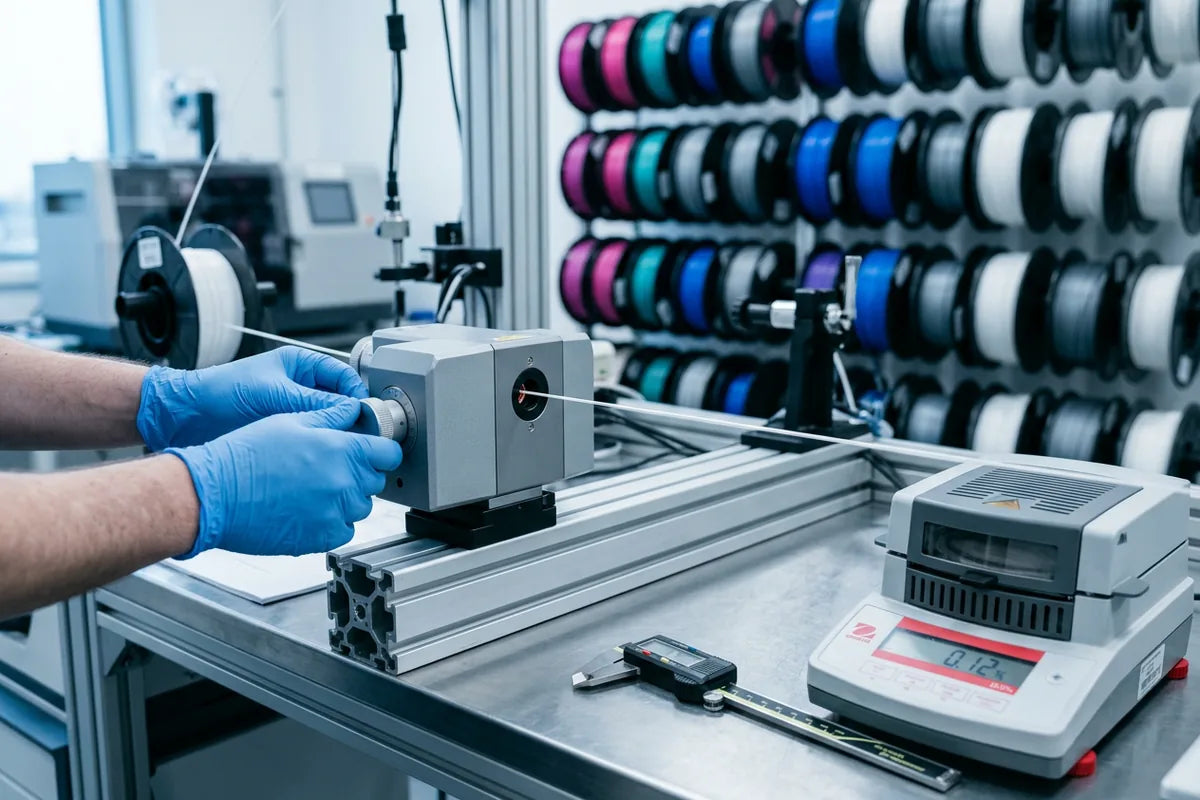
On your own machines, in your own conditions, against the prints your customers actually make. Micrometer on two axes along the strand, weigh the spool sealed and again empty, unwind the last 200 g looking for crossovers, then a temperature tower, a retraction test, a dimensional cube and one job of eight hours or more.
-
Approval
Owned by:You
Sign off three physical things and one document: a golden sample sealed and dated with its batch code, a printed label proof applied to a real spool, a packaging sample, and the specification sheet itself. A PDF is not an artwork proof and a photograph is not a sample.
-
Production
Owned by:Factory
The run is scheduled and extruded. Agree before the deposit what is allowed to change between the approved sample and the run, what happens if the line drifts, and who is told when it does.
-
Quality control
Owned by:Factory, verified by you
Diameter, ovality, moisture at pack, color against the approved reference and net weight — each with a number and a measurement method beside it in the purchase order. Ask for the pre-shipment figures while the goods are still in the factory, because that is the last point at which a problem is cheap.
-
Shipping
Owned by:You, with your forwarder
Incoterms in writing, HS code confirmed, duty and destination charges estimated, and somewhere for a pallet to go when it lands. EXW, FOB, CIF and DDP are four different numbers, not four names for one price.
Steps 2 to 4 carry the whole run. An error found at production costs a run; the same error found at the sample costs a spool.
Material selection, before anything gets customized.
Color and packaging are reversible decisions. The material is not: it sets the minimum order, the packaging requirement, the support load and the return rate, and it decides which factories can quote you at all. Choose it from what your customers print, then check it against what the plant is actually running this month.
-
START FROM THE APPLICATION
Display parts, functional parts, outdoor parts, flexible parts and engineering parts are five different materials bought by five different people. A range assembled from a price list instead of from applications ends up broad, shallow and slow-moving.
-
THE VOLUME TIER
PLA and the specialty PLAs carry most consumer unit volume, print easily and generate the fewest support emails. They are also the most crowded shelf in the category, so the competition is on price and color rather than on specification.
-
THE FUNCTIONAL TIER
-
FILLED AND SPECIALTY GRADES
Carbon- and glass-filled grades carry the highest margin in the category and are the hardest to source consistently. They also need a hardened nozzle at the customer’s end, which turns a share of your first-year support into an equipment conversation.
-
CHECK WHAT IS RUNNING NOW
Ask which materials are in production this month, which are made to order, and which are listed but not currently running. A catalog that never says no is a trading company’s catalog. VANYO runs PLA, PLA+, specialty PLA, PETG, PETG-CF, ASA and TPU-95A; ABS, PC and PA-CF are not in production.
In production today
-
THE MATERIAL SETS THE PACKAGING
PETG, TPU and the nylons take up moisture fastest and punish thin packaging and long shelf time hardest. The material you choose sets the sealing specification, not the other way round — so decide both in the same conversation rather than two months apart.
What actually sets an OEM filament MOQ.
“What is your MOQ?” is the first question most buyers ask and the least useful one, because there is no single number behind it. A minimum order is assembled from several independent minimums stacked on top of one another — an extrusion minimum per material, a separate minimum per color, print minimums for labels and for cartons, sometimes tooling — and which one binds depends entirely on how much of the run is custom.
So ask for it in parts. A supplier who answers with one number for everything has either not understood the question or is quoting you stock they do not make. VANYO quotes private-label and OEM minimums per project, against the specification you send, because the answer moves with every line in the table below; wholesale, where nothing is customized, starts at one carton of 20 spools.
| Driver | What it is, and what moves it |
|---|---|
| PER MATERIAL | The quantity that makes an extrusion setup worth running: purge, line stabilisation and the scrap between one compound and the next. Usually the largest single number in a quote, and the one that falls fastest when you consolidate colors. |
| PER COLOR | A separate minimum for every color, because every color is a compound change and a line purge. Ten colors is ten minimums, not one order split ten ways — the most common budgeting mistake in a first OEM run. |
| STOCK COLOR VS MATCHED COLOR | A stock color runs against masterbatch the factory already holds and carries the lower minimum. A matched color adds a development step, usually a matching fee, and a higher minimum run. Ask for both numbers before fixing a palette. |
| PER FINISHED SKU | The smallest useful quantity of one finished, labelled, boxed, barcoded unit. Ask for the minimum three ways — per material, per color, per finished SKU — and the gaps between the three tell you where the cost actually sits. |
| LABEL PRINT MINIMUM | Set by the label printer rather than the extruder, and usually the cheapest branding available. Often low enough that labels are not what constrains a first order. |
| CARTON AND BOX PRINT MINIMUM | Typically far higher than labels, and frequently the single line that pushes a first order past budget. Ask what a run costs with printed labels and plain cartons before assuming you need both printed. |
| SPOOL FORMAT AND TOOLING | Standard spools come off tooling that already exists. A custom mould, a non-standard core or a molded-in brand mark is tooling: a one-off cost, a lead time of its own, and a minimum large enough to amortize it. |
| CUSTOM FORMULATION | An additive package or filled grade written for you sits at the top of the minimum ladder, because it is a compound development rather than a color change. Check the existing catalog first — most requests are already met by something running. |
| PACK CONFIGURATION | Multipacks, mixed assortments, inserts and retail-ready cartons are labor at packing. They rarely move the extrusion minimum and routinely move the price per unit. |
| LEAD TIME AND SCHEDULING | Minimums and lead times move together — a smaller run often means waiting for a slot behind a larger one. Ask for sample, in-stock, made-to-order and custom-color lead times as four separate figures, and ask what happens to them in Q4 and around factory holidays. |
Custom colors, and how color matching is actually judged.
Color is the customization buyers reach for first and specify worst. It is also one of the few things an OEM or private-label run gives you that reselling cannot — a color nobody else is allowed to list. Getting it right is a question of how the match is judged and whether it can be reproduced next year, not of how good the first spool looks in a photograph.
-
STOCK COLOR OR YOUR OWN
A stock color runs against masterbatch the factory already holds: lowest minimum, shortest lead time, and a color your competitors can buy too. A custom color is a compound change with its own minimum, its own fee and its own schedule. Most first ranges do better with stock colors plus one signature color that is genuinely yours.
-
SEND A PHYSICAL REFERENCE
Screens lie and photographs lie harder. Send a physical object — a printed part, a competitor’s spool, a paint chip, a color chip — and ask for it back with the sample, so both parties end up holding the same reference rather than two descriptions of it.
-
HOW THE MATCH IS JUDGED
This is the question that separates suppliers: is the match judged by eye, or by colorimeter against a stated number? Ask for ΔE against an approved reference. VANYO publishes ΔE ≤1.0 against the approved reference. A match judged by eye holds only until the person doing the judging changes.
ΔE ≤1.0 to approved reference
-
BRAND PALETTES AND CHIPS
A printing-ink chip is a reference for ink on paper, not for pigment in polymer, and some colors cannot be reached at all in a filled, matte or translucent material. Ask which of your brand colors are reachable in each material before a range is designed around them.
-
THE MATERIAL CHANGES THE COLOR
The same masterbatch reads differently in PLA, PETG and ASA, and differently again in a matte or filled grade. A range that has to look like a range across three materials needs a reference and an approved sample per material, not one reference used three times.
-
SPECIALTY AND EFFECT COLORS
Silk, matte, metallic, dual-color, glow and fluorescent are appearance products. They sell on photographs and they punish inconsistency hardest, because the exact thing that varies between runs is the thing the customer was buying.
-
REPRODUCING IT NEXT YEAR
The important color question is not the first run, it is the fourth. Ask what is retained between runs — the masterbatch formula, a physical reference, a colorimeter reading — and who holds it. Then keep your own sealed retained sample, dated, whatever the answer was.
-
WHAT A COLOR QUOTE MUST CONTAIN
Four things: the minimum run for that color, the matching fee if there is one, the matching lead time stated separately from the production lead time, and the tolerance the match will be held to. A color quote missing any of the four is not a quote.
-
COLOR COUNT IS A BUDGET DECISION
Every color is a separate minimum, a separate SKU, separate photography and separate stock sitting in a warehouse. Black, white and grey do most of the volume in most filament ranges. Launch narrow, and add the colors your customers ask for twice.
Custom formulations, where they make sense and where they do not.
Most requests described as “custom filament” are colors and packaging. A genuinely custom formulation — a different additive package, a filled grade, a modified impact or heat profile — is a materials development project with its own cost, its own minimum and its own timeline. Worth doing when the property is the product. Worth avoiding when it is not.
-
WHAT COUNTS AS A FORMULATION CHANGE
Additive packages, filled grades, impact modifiers, heat-resistance changes and effect compounds — anything that changes what the polymer does, rather than what it looks like or what it is wound onto. A color is not a formulation; a matte compound arguably is.
-
CHECK THE CATALOG FIRST
Most “we need a custom grade” conversations end at an existing product. A filled PETG, a higher-impact PLA or a UV-stable ASA usually already exists somewhere in a manufacturer’s range. Ask what is running before paying to develop something twice.
-
WHAT DEVELOPMENT INVOLVES
Compound trials, small extrusion runs, testing, iteration, then a first production run. Expect several rounds, expect a development cost, and expect the minimum on the finished grade to be the largest number in the whole project.
-
WHO OWNS THE RESULT
Agree in writing, before development starts, whether the formulation is yours, the factory’s or shared, and whether it can be sold to anyone else. An implied exclusivity is not one. If it matters commercially, put a scope and a duration against it.
-
WHAT YOU CAN ACTUALLY VERIFY
A formulation claim is worth exactly as much as the test behind it. Decide which properties you will measure, to what standard, and who pays for the testing. Ask what documentation exists per material, and read anything described as a “certification” carefully — producer statements and third-party certifications are not the same document.
-
FILLED GRADES ARE THE COMMON CASE
Carbon- and glass-filled grades are where most real formulation demand sits: stiffness, dimensional stability, and a spec-driven buyer who will pay for both. They wear tooling faster and demand tighter process control, which is why fewer factories run them well. VANYO runs PETG-CF; other filled or additive grades are quoted on request.
PETG-CF in production
Spool, label, box and barcode customization.
This is the part of an OEM run your customer holds, photographs and reviews — and the part most often left to whatever the factory does by default, because nobody wrote it into the specification. Decide every line below deliberately. Each one is either your brand or somebody else’s.
-
SPOOL FORMAT
Weight, outer diameter, width, core diameter and hub design. The core and the hub matter more than they look: they decide whether a spool fits an automated changer, a farm rack or a dry box. Standard formats come off existing tooling; anything else is a mould with a mould’s cost and lead time.
-
SPOOL MATERIAL AND COLOR
Cardboard is lighter, cheaper to ship and increasingly expected on environmental grounds. Plastic is more rigid, reusable and easier to wind tightly. Spool color, and whether a brand mark is printed or molded in, is a customization on either — with different minimums for each.
-
WINDING
The invisible quality signal. A spool wound at inconsistent tension develops crossovers that jam a print two-thirds of the way through a long job — the failure your customer blames on the filament and reviews you for. Ask what the winding specification is, and treat “we do not publish one” as a real and useful answer.
-
THE SPOOL LABEL
Your artwork, and also a working document: brand, material, color name and code, diameter, net weight, print window, drying guidance, your SKU, your GTIN and a batch or date code. Ask for print-ready file specifications and a physical proof applied to a real spool — not a PDF of one.
-
VACUUM BAG AND DESICCANT
Filament takes up water from the air and prints badly once it has. The standard is a vacuum-sealed bag with desiccant. Ask whether humidity is measured at sealing or assumed, to what figure, and whether the bag itself can be printed. VANYO specifies sealing below 10% RH at pack.
Sealed below 10% RH at pack
-
THE SPOOL BOX
Individual cartons printed to your artwork — or none at all, since plenty of brands ship the sealed bag inside a plain mailer and put the money into the label instead. Decide it on how the product is sold: retail shelf, marketplace listing, or pallet into a print farm.
-
MASTER CARTON AND PALLET
Count per carton, carton dimensions and weight, and the markings your warehouse or 3PL receives against. Get this right and inbound is scan-and-shelve; get it wrong and every pallet becomes a manual receipt somebody has to be paid for.
-
BARCODES AND SKUS
Buy your own GS1 prefix and issue your own GTINs. A product listed under a factory’s barcodes cannot change supplier without re-listing everything and losing its review history. Your own SKU scheme belongs on the label and on the carton, so stock arrives scan-ready instead of needing a relabel.
-
INSERTS AND MULTIPACKS
A printed card carrying the drying schedule and print window, a QR code to your own support page, mixed-color multipacks, sample kits and retail-ready assortments. All of it is packing labor rather than extrusion, so it is priced and minimum’d on a different basis from the filament.
Samples, testing and approval.
A sample is the only evidence that exists before money moves, and the sample stage is the first thing compressed when a launch date slips. Two weeks and a few failed prints here is the cheapest insurance available in the entire project.
-
ASK FOR PRODUCTION SAMPLES
A spool made specially for you shows what a factory can do on its best day with somebody watching. A spool pulled from current production shows what you will actually receive every month. Ask for both, ask what each costs, and ask whether it is credited against a first order.
-
MEASURE IT YOURSELF
Micrometer rather than calipers, two perpendicular axes, twenty or thirty readings along the strand. Twenty minutes of work gives you a real tolerance and a real ovality figure instead of a quoted one — and a number you can hold a supplier to later. The full method is in filament ovality and diameter tolerance, explained.
-
WEIGH IT
Weigh the sealed spool, then weigh the empty spool once you have printed it out. The difference is your actual net weight. Short weight is the quietest way a good price per kilo turns out not to be one.
-
UNWIND THE LAST 200 G
Winding faults live at the end of the spool. Unwind the tail by hand and watch for crossovers, trapped strands and tangles. It is the single most predictive test for the long-print complaint you would otherwise first hear about from a customer.
-
PRINT WHAT YOUR CUSTOMERS PRINT
A temperature tower for the usable window, a retraction test for stringing, a dimensional cube for accuracy, and at least one job of eight hours or more — run twice, from two different spools, on a machine your customers actually own rather than the best one you have.
-
APPROVE PROPERLY
Approval is three physical objects and one document: a sealed, dated golden sample with its batch code, a printed label proof on a real spool, a packaging sample, and a signed specification sheet. Everything produced afterwards is measured against those four things.
VANYO sends one 1 kg spool per candidate material at carton pricing, credited against your first carton order.
 ±0.02 MM
The quality lines to write into the purchase order.
Quality control is not a promise, it is a list of parameters with a number and a measurement method against each one. These are the lines worth specifying in writing before a run is scheduled — with, against each, what VANYO publishes and what it deliberately does not.
- DIAMETER
- 1.75 mm ±0.02 mm±0.05 mm is commodity, ±0.03 mm competent, ±0.02 mm tight. Ask what measures it and what happens when it drifts. An inline laser gauge reads ours on two axes continuously during extrusion and stops the line automatically if either axis leaves ±0.02 mm.
- OVALITY
- ≤0.02 mmRound matters as much as thin, because an oval strand meters unevenly through an extruder. Ask for ovality as a separate published number, and ask whether the gauge reads one axis or two. Ours reads two, and our ovality figure is taken off that same measurement.
- MOISTURE AT PACK
- Sealed below 10% RHAsk whether material is dried before extrusion, sealed under vacuum with desiccant, and whether the humidity at sealing is measured or assumed.
- COLOR
- ΔE ≤1.0 to referenceAgainst an approved physical reference, so the second run matches the first. Ask what is retained between runs, and who holds it.
- NET WEIGHT
- 1 kg per spoolAsk for net weight, its tolerance and the spool tare as three separate figures, then weigh a sample yourself before the run is scheduled.
- BATCH CONSISTENCY
- Approved sample retainedAsk what is allowed to change between runs, and whether out-of-spec material is scrapped or blended back into later batches. Scrapped is the answer you want to hear.
- WINDING & FEED TEST
- Not publishedWe publish no winding specification and no test-feed procedure. We would rather say so than let you assume one exists.
- PRINT TESTING
- Every batch, on our own machinesWe test-print every batch on our own machines and check it feeds and prints cleanly. We do not publish a named test part, and it is a process check rather than a document — we issue no per-batch report.
- DOCUMENTS
- SDS, RoHS, REACHA safety data sheet per material, with RoHS and REACH statements on request. These are producer statements, not third-party certifications, and a technical buyer knows the difference.
- WHAT IS NOT CLAIMED
- No ISO 9001, no CoAWe do not hold ISO 9001, do not issue certificates of analysis or per-batch test reports, and do not offer lot-level traceability. If an OEM pitch includes all three, ask to see one.
Ask how each figure is measured and how often. A tolerance with no method behind it is a marketing number. Ask too what a supplier does not claim — in this category the gaps are usually more informative than the claims.
- SDS PER MATERIAL
- ROHS STATEMENT
- REACH STATEMENT
What to send an OEM filament manufacturer, and what to ask for back.
Most OEM enquiries arrive as “what is your MOQ and price?”, which cannot be quoted and starts a fortnight of email. Send the middle column, ask for the right-hand column, and a factory can price your run in one pass — and the quotes that come back will be comparable to each other. Our quote form asks for most of it already.
| # | Topic | Send or ask this | A usable answer contains |
|---|---|---|---|
| WHAT TO SEND | |||
| 1 | MATERIAL AND GRADE | The material, the grade, and the application behind it. The application matters — it tells a factory whether something already running fits. | Confirmation the material is in production this month, or a straight no and a reason. |
| 2 | DIAMETER AND TOLERANCE | The diameter you need and the tolerance you need, stated as a number rather than as “tight”. | The tolerance they hold, what measures it, how often, and whether the figure is a maximum or a standard deviation. |
| 3 | COLOR | Stock color names, plus a physical reference for anything custom. Say how many colors and roughly how the volume splits between them. | A minimum run per color, a matching fee if any, a matching lead time separate from production, and the ΔE the match will be held to. |
| 4 | SPOOL AND PACKAGING | Spool weight, core and hub requirements, the sealing requirement, and whether you need printed labels, printed boxes or both. | What comes off existing tooling versus what needs a mould, with label and carton print minimums quoted as separate numbers. |
| 5 | ARTWORK, BARCODES AND SKUS | Label and carton artwork or a layout, your GTINs, your SKU scheme, and the carton marking format your warehouse receives against. | Print-ready file specifications, a named artwork contact, and a physical printed proof on a real spool before the run. |
| 6 | VOLUME AND FORECAST | First-order volume and a twelve-month forecast if you have one — clearly labelled as which is which. | Price at your volume and at the next tier up, so you can see where the breaks actually are. |
| 7 | DESTINATION AND INCOTERMS | Delivery country, port or door, and the Incoterms you want quoted against. | EXW, FOB and DDP as separate numbers rather than one blended price with the freight buried in it. |
| WHAT TO ASK | |||
| 8 | PRODUCER OR AGENT | Do you own the extrusion lines that will run this order, and what is the plant address? | A plant address, a count of the lines running your material, and a willingness to do a live video call from the floor. |
| 9 | MOQ, THREE WAYS | What is the minimum per material, per color, and per finished SKU? | Three separate numbers, with label and carton print minimums quoted separately again on top. |
| 10 | LEAD TIMES, FOUR WAYS | What are your sample, in-stock, made-to-order and custom-color lead times? | Four separate figures, plus what happens to all four in Q4 and around factory holidays. |
| 11 | SAMPLES | Can I have a spool made to my specification and a spool from current production? What do they cost, and are they credited? | Both offered, with a cost and a credit policy stated up front rather than negotiated later. |
| 12 | FAILED MATERIAL | What happens to material that fails inspection — is it scrapped, or blended back into later batches? | Scrapped. Reworking failed material into later runs is where run-to-run inconsistency is manufactured. |
| 13 | CUSTOM FORMULATION | Is what I am asking for an existing grade in your catalog, or a development? What does development cost and how long does it take? | An honest answer either way, with development cost, iteration count and the finished-grade minimum stated before anything starts. |
| 14 | WHAT IS DOCUMENTED | Which documents do you issue per material, and which do you not issue? | An SDS at minimum, RoHS and REACH statements commonly, and a clear no on certificates of analysis, lot traceability and ISO marks unless they genuinely hold them. |
| 15 | RETAIL AND MARKETPLACE PREP | Can you apply retail or marketplace barcodes at packing, and mark master cartons to my format? | A yes or a no, not a maybe. The answer decides whether you need a prep centre, and that changes your landed cost per spool. |
| 16 | EXCLUSIVITY | Is any color, formulation or territory exclusive to me, and for how long? | A scope and a duration in writing, or a clear no. An implied exclusivity is not one. |
| 17 | PAYMENT TERMS | Deposit percentage, balance trigger, and what happens if pre-shipment figures miss the specification. | Terms in writing, with the pre-shipment check named as the balance trigger rather than the bill of lading. |
| 18 | DEFECTIVE LOTS | What happens if a run misses the agreed specification after it has shipped? | A written remedy — replacement, credit or rework — agreed before any deposit is paid. |
| 19 | REPEAT RUNS | How is this same grade and this same color reproduced twelve months from now? | A retained reference, a retained sample and a named process. This question separates a producer from a broker faster than any other on the list. |
Send the identical document to every supplier you are quoting. Identical inputs are what make prices comparable; different inputs are what make a cheap quote look cheap.
OEM and custom filament, answered.
What does OEM 3D printer filament mean?
Filament produced by a manufacturer to a specification you set and sold as finished goods under your own brand. You own the product, the specification and the forecast; the factory owns the plant, the process and the packing. In practice a large share of what is sold as OEM is nearer ODM — the factory’s existing formulation in your color and your packaging — so ask in writing which of the two you are being quoted.
The 2026 sourcing guide covers the same ground from the measurement side, including what moves a minimum order and how to audit the samples you get back.
What is the difference between OEM, private label and wholesale filament?
Wholesale is the factory’s own brand at volume pricing, with nothing customized. Private label is the factory’s product in your packaging. OEM is filament made to your specification, under your brand. Most buyers do best moving through them in that order: wholesale proves the material sells, private label proves the brand does, and OEM makes sense once volume and specification both justify it. The three are compared row by row further up this page.
What is the MOQ for OEM or private label filament?
There is never one number. A run carries an extrusion minimum per material, a separate minimum for every color, print minimums for labels and cartons, and sometimes tooling. Ask for the minimum per material, per color and per finished SKU as three separate figures, and ask for the print minimums on top. VANYO quotes private-label and OEM minimums per project against the specification you send; wholesale, where nothing is customized, starts at one carton of 20 spools.
Can I get custom color 3D printer filament made for my brand?
Yes, and it is one of the few real advantages an OEM run has over reselling. Send a physical reference rather than a screen color, and ask three things: the minimum run for that color, whether the match is judged by eye or by colorimeter to a stated ΔE, and what is retained so the color can be reproduced next year. VANYO produces custom colors on its own lines and publishes ΔE ≤1.0 against the approved reference; minimum run and lead time are quoted per color.
How is filament color matching actually done?
Properly, it is a colorimeter reading against an approved physical reference, held to a stated ΔE. Loosely, it is two people comparing two spools under a factory light. Ask which one you are buying. Note also that the same masterbatch reads differently in PLA, PETG and ASA, so a range that has to look consistent across materials needs an approved reference for each one.
What can be customized on the spool and the packaging?
Spool weight, core and hub, spool material and color, the label, the vacuum bag, the individual box, master carton markings, inserts, multipack configurations, and your own GTINs and SKUs. What tends to be fixed is tooling — spool moulds and core dimensions — so ask early which of your requirements are a print change and which are a mould. What VANYO can put your brand on is listed in full on the private label page.
Do I need my own barcodes for an OEM filament line?
Yes, if you intend to be a brand rather than a reseller. Buy your own GS1 prefix and issue your own GTINs. A product listed under a factory’s barcodes cannot change supplier without re-listing every item and losing its review history — an expensive dependency that costs almost nothing to avoid at the start.
Can a manufacturer develop a custom filament formulation for me?
Some can, but check the catalog first: most “custom grade” requests are already met by an existing product. A genuine formulation change is a compound development with trials, iterations, a development cost and the highest minimum in the project. Agree who owns the result, and whether it can be sold to anyone else, before development starts. VANYO runs PETG-CF; other filled or additive grades are quoted on request.
How do I test an OEM filament sample properly?
Micrometer on two perpendicular axes at twenty or thirty points along the strand, weigh the spool sealed and again once empty, hand-unwind the last 200 g looking for crossovers, then print a temperature tower, a retraction test, a dimensional cube and at least one job of eight hours or more — twice, from two spools, on a machine your customers own. Ask for a spool from current production as well as one made to your specification, because they are not the same evidence.
What documents can an OEM filament manufacturer provide?
A safety data sheet per material is standard, and RoHS and REACH statements are common. These are producer statements rather than third-party certifications, and the difference matters to a technical buyer. VANYO issues an SDS per material with RoHS and REACH statements on request, and does not hold ISO 9001, does not issue certificates of analysis or per-batch test reports, and does not offer lot-level traceability. The supplier evaluation guide covers what is worth verifying and how.
Send the specification. Pricing follows in one business day.
SEND US
- Material and grade
- Color, or a reference to match
- Spool, label and packaging spec
- Volume, forecast and destination
YOU GET BACK
- Pricing at your volume
- Minimums quoted per project
- One 1 kg sample spool per material
- At carton pricing, credited against your first carton order
WHAT WE PUBLISH
- 1.75 mm at ±0.02 mm, ovality ≤0.02 mm
- Sealed below 10% RH at pack
- ΔE ≤1.0 to approved reference
- SDS, RoHS and REACH statements
- No ISO 9001, no CoA, no lot traceability