
2026 Private Label 3D Printer Filament Sourcing Guide
A working reference for anyone choosing a filament manufacturer this year, written from inside a filament plant. What to measure, how to measure it, what actually moves a minimum order, and which answers from a supplier are worth anything. The measurement protocol in the middle of this guide is free to reuse against any factory, ours included.
- SPOOL AUDIT PROTOCOL
- MOQ DRIVERS
- TEN SUPPLIER QUESTIONS
- WHAT WE PUBLISH
- WHAT WE DO NOT
Nothing here is gated and nothing sits behind a form. The protocol, the tables and the question set are meant to be used against any manufacturer.
Price is the easiest thing to compare and the least useful.
Two quotes for 1.75 mm PLA can sit a few cents apart and describe completely different products. The difference turns up later: the spool that runs 40 g light, the second batch that prints a shade off the first, the roll that jams at the fourteen hour mark because a wrap crossed under another. Everything below is something you can specify, measure or ask about before money moves. Minimums, customization and quality control get their own sections further down.
-
MATERIAL CONSISTENCY
Ask which resin grade the factory buys and whether it changes between runs. A plant that switches resin suppliers on price hands you a batch that prints differently at the same temperature, and no downstream inspection catches that.
ASK BEFORE YOU QUOTE
-
DIAMETER CONTROL
A tolerance figure on its own means very little. What matters is what measures it, how often, on how many axes, and what happens automatically when the reading drifts.
COVERED IN DETAIL BELOW
-
MOISTURE
PETG, TPU, nylon and PC pick up water in storage and in transit. Ask what the moisture level is at the moment the bag is sealed, what the bag is, and whether desiccant goes in. A wet spool becomes your return, not the factory’s.
WHERE RETURNS COME FROM
-
COLOR
The first run is easy. The eighth run, eleven months later, against a reference that may or may not have been kept, is the real test. Ask what is retained between runs and how the match is judged.
REPEATABILITY, NOT APPEARANCE
-
WINDING
Rarely specified, frequently the reason an overnight print fails. Ask for a specification. Most factories, ours included, do not publish one, which tells you to test it yourself.
TEST IT YOURSELF
-
NET WEIGHT
Net filament weight, spool tare and the tolerance on the net figure are three different numbers. Get all three in writing before you print 1 KG on a label you are legally responsible for.
THREE NUMBERS, NOT ONE
-
PACKAGING
Spool, bag, desiccant, label, individual box, master carton, barcode. Each one is a decision. Anything you leave blank, the factory decides for you, and you find out at the port.
SPECIFY EVERY LINE
-
SAMPLING
A sample built by hand to impress you is not the product. Ask for a spool pulled from current production alongside the sample made to your spec, and measure both.
TWO SPOOLS, NOT ONE
-
REPEATABILITY
The question underneath all of the above. What stops run eight from differing from run one? The answer is a written specification, a retained physical reference, and an agreed remedy for when the goods miss it.
THE ONE THAT MATTERS
Everything in this guide applies to any manufacturer. Where VANYO appears it is because a worked example beats an abstraction, and where we cannot answer something the guide says so.
Wholesale, private label, OEM and ODM are four different purchases.
These four words get swapped around freely in this industry, and that is the main reason two quotes come back looking similar and behaving nothing alike. Settle the model in the first email. The procurement detail behind each one sits on the OEM filament page; what follows here is the decision itself.
| # | Model | What is yours | MOQ and development load |
|---|---|---|---|
| BUY IT AS IT IS | |||
| 1 | WHOLESALE | Nothing. The factory’s brand, on its spool, in its box. You buy volume and resell it. | Lowest minimum, no artwork, no tooling, no development. The right first step if you are still testing whether the material sells at all. |
| PUT YOUR NAME ON IT | |||
| 2 | PRIVATE LABEL | Branding and packaging. Your label on the spool, usually your box, sometimes your spool color. The formulation stays the factory’s. | Set by whichever print minimum is highest: labels, cartons or the color run. Development is artwork and approvals, measured in days rather than months. |
| 3 | PRIVATE LABEL + CUSTOM COLOR | All of the above, plus a color that belongs to you. | Adds a masterbatch minimum and a line changeover. Ask for the color minimum as a separate figure from the material minimum. Quoted together, they hide which one is actually binding. |
| SPECIFY IT YOURSELF | |||
| 4 | OEM | The specification. Material, grade, tolerance, spool format, packaging and the quality lines in the purchase order. Extruded to what you wrote. | Higher, because the run is yours alone and the line is set up for it. Development runs to weeks: sample, test, revise, approve. |
| 5 | ODM | The brand, usually the color and the packaging. The formulation and the development work stay the factory’s. | Between private label and OEM. A large share of what is sold as OEM in this category is really ODM, so ask in writing which one you are being quoted. |
A supplier who offers all four without distinguishing between them is usually a trading company. Ask which lines are theirs, and ask to watch one running.
Pick three. Not eleven.
The most expensive mistake in a first private label run is breadth. Every material carries its own minimum, its own drying behaviour, its own support load and its own set of customer complaints. A brand launching nine at once ties up cash in slow SKUs while learning nine sets of problems simultaneously. Two or three materials, a short color list, and a second wave once you know what actually sells.
-
PLA
The volume material and the one that funds everything else. Easy to print, forgiving of moisture, sells on color and finish rather than on specification. The shelf is crowded, so a PLA line lives or dies on colors and packaging, not on data. Our PLA range is the reference point for what a stock catalogue looks like.
EASY · CROWDED SHELF
-
PLA+ AND SPECIALTY PLA
Silk, matte, metallic, glow, fluorescent and dual color variants. Same printing behaviour, much better margin, and the differentiation is visible in a product photo, which matters more than most technical arguments when a hobby buyer is choosing. The trap is SKU count: specialty finishes multiply fast.
EASY · BETTER MARGIN
-
PETG
The first functional material most brands add, and the first place moisture becomes a real support cost. Tougher than PLA, more temperature resistant, prints in a wider window but strings when wet. Expect your complaint volume per kilo to rise the month you launch it. PETG here.
MODERATE · MOISTURE SENSITIVE
-
ABS
Needs an enclosure, warps without one, and smells. Still specified in automotive and electronics work because it machines and solvent welds well. A hard material to sell to a consumer audience and a reasonable one to sell to an industrial audience. Not currently extruded on our lines.
DIFFICULT · NOT IN PRODUCTION HERE
-
ASA
The genuinely underserved one. ABS-like mechanical behaviour with real UV stability, which makes it the answer for anything mounted outdoors. Harder to extrude consistently, which is exactly why a factory that gets it right can prove something with it. ASA here.
DIFFICULT · UNDERSERVED
-
TPU
Flexible, and the material most sensitive to the printer rather than to the filament. Direct drive feeds it, long bowden paths fight it, and diameter consistency matters more here than anywhere else because a soft strand buckles instead of pushing. Shore hardness is the specification buyers actually compare. TPU-95A here.
DIFFICULT · FEED PATH DEPENDENT
-
PC
High temperature resistance, high strength, and thirsty enough that it can absorb enough moisture to print badly within a few hours of opening. A specialist material for a specialist audience, and a poor choice for a first line. Not currently extruded on our lines.
DIFFICULT · NOT IN PRODUCTION HERE
-
PA AND NYLON
The most hygroscopic material in common use, and the one where packaging and drying advice stop being nice to have. Excellent wear and impact behaviour, which is why it survives in functional and industrial work despite being difficult in every other respect. Not currently extruded on our lines.
DIFFICULT · NOT IN PRODUCTION HERE
-
CARBON FIBRE FILLED
Stiffer, more dimensionally stable, and abrasive enough to wear a brass nozzle out in an afternoon. Filled grades also wear the die, which is the part buyers never ask about: ask whether the published tolerance holds across a filled run and how often the die is changed. We run PETG-CF; ask about anything else rather than assuming it.
ABRASIVE · TOOLING COST
Materials not on a factory’s current production list can usually still be quoted, sourced from somebody else’s line. That is a legitimate answer and a different product. Ask which it is.
The tolerance number is the least interesting part of the tolerance.
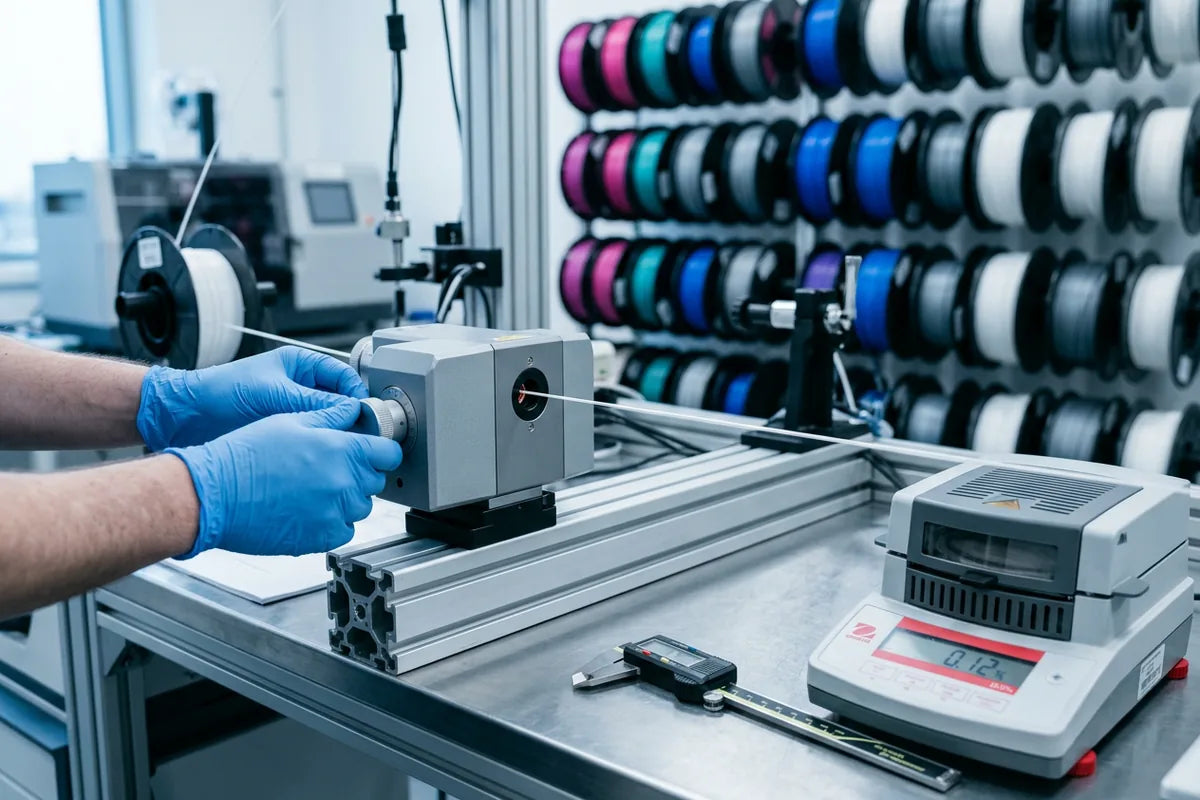
Diameter is the specification every filament brand publishes and almost nobody qualifies. A slicer assumes the strand is exactly the nominal diameter you typed in, and the extruder pushes a fixed length of it per unit of time. When the real diameter drifts up, the printer over-extrudes: rough surfaces, dimensions growing. When it drifts down, walls thin and layers under-bond, and the part fails somewhere it was not supposed to. The tolerance figure is a promise about how far that drift is allowed to go. Who is watching, on how many axes, how often, and what happens when it goes out are the parts that decide whether the promise means anything.
-
NOMINAL VERSUS TOLERANCE
Nominal is the target, 1.75 mm or 2.85 mm. Tolerance is the band around it. ±0.02 mm and ±0.05 mm sound like near neighbours and are not: the second permits roughly two and a half times the variation in cross section, which the printer experiences as flow error.
-
MAXIMUM OR STANDARD DEVIATION
The question almost nobody asks. ±0.02 mm quoted as a maximum deviation means no reading anywhere on the spool leaves the band. The same figure quoted as a standard deviation means around a third of the spool is permitted outside it. Same number on the label, different products. Ask which, in writing. We are resolving the same question about our own published figure and have not answered it yet, so we do not characterise it either way.
ASK IN WRITING
-
ONE AXIS OR TWO
A single axis gauge measures one chord through the strand and cannot see an oval. Two axes at ninety degrees can. If a supplier publishes an ovality or roundness figure but measures on one axis, that figure is an assumption rather than a measurement. Ours reads two, and our ovality figure comes off the same measurement. The full breakdown — what an oval strand does to a print, and the caliper method that catches it — is in filament ovality and diameter tolerance, explained.
THE QUESTION THAT SORTS SUPPLIERS
-
WHAT VARIATION DOES DOWNSTREAM
Flow error compounds. A slow drift across a metre of filament shows up as banding on a curved surface. A fast excursion across a few centimetres shows up as a blob or a gap. In an automated changer or a long bowden path, an oval strand binds where a round one feeds.
-
HOW OFTEN IT IS MEASURED
Continuous and inline during extrusion is the answer you want. Spot checks at the start and end of a run tell you about the start and the end of the run. Then ask what the gauge actually does when a reading leaves the band: log it, alarm it, or stop the line.
-
MEASURE IT YOURSELF ANYWAY
Not because the factory is lying, but because measurement is cheap and disputes are not. The protocol below is the version we would hand a buyer who asked us how to audit us.
The spool audit protocol, v1.0
Most sourcing advice tells a buyer to test the samples and stops there. This is the part that gets skipped: what to measure, how many times, where on the spool, and what to write down so that two spools from two suppliers can actually be compared against each other. It is written for a buyer with a digital micrometer, a scale and a printer, not for a materials lab. Run it identically on every candidate and the comparison holds.
Reuse it, print it, put it in a purchase order, publish your own results with it. Attribution is appreciated and permission is not required.
| # | Step | Method | What you record |
|---|---|---|---|
| BEFORE YOU OPEN THE BAG | |||
| 1 | SEALED WEIGHT | Weigh the spool sealed, in its bag, on a scale reading to 1 g or better. Do not open it yet. | Sealed gross weight in grams. Photograph the bag, the label and any desiccant sachet through the plastic. |
| 2 | PACKAGING RECORD | Note the bag type, whether it is vacuum drawn or simply heat sealed, whether desiccant is present and how much, and whether a humidity indicator card is included. | A written description and a photograph. This is the baseline you will hold the production delivery against six months later. |
| DIAMETER | |||
| 3 | SAMPLING PLAN | Take ten measurement points spread across the spool: three in the first 100 g, four through the middle, three in the last 100 g. Mark the filament as you unwind so you can return to a point. | Point number and its approximate position on the spool by mass. |
| 4 | TWO AXIS READING | At each point take two readings ninety degrees apart with a digital micrometer reading to 0.001 mm. Calipers are not accurate enough for this and will flatter a bad spool. | Twenty readings in total: axis A and axis B at each of the ten points. |
| 5 | DEVIATION | Subtract the nominal diameter from each of the twenty readings. | Largest positive deviation, largest negative deviation, and the mean of the absolute deviations. Compare the largest against the supplier’s published tolerance. |
| 6 | OVALITY | At each point, ovality is axis A minus axis B, taken as an absolute value. | The largest of the ten values, in mm. This is the number a single axis gauge cannot produce. |
| WEIGHT | |||
| 7 | NET WEIGHT | Print out or discard the filament until the spool is bare, then weigh it. Net weight is the sealed weight minus the bag, the desiccant and the bare spool. | Claimed net, measured net, and the difference expressed in grams and as a percentage. |
| 8 | SPOOL TARE | Weigh the bare spool on its own. | Tare in grams. Useful afterwards for estimating remaining filament by weight, and worth writing into the specification as a figure with a tolerance. |
| MOISTURE | |||
| 9 | CONDITION AT OPENING | If a humidity indicator card is in the bag, read it within a minute of opening. Without a card, the practical proxy is a print straight from the bag against the same print after four hours of drying. | The indicator reading, or the two prints photographed side by side under the same light. |
| 10 | DRYING RESPONSE | Dry a 200 g offcut at the material’s recommended schedule, weighing before and after on a scale reading to 0.1 g. | Mass lost in grams. A meaningful loss means the spool arrived wet, whoever is at fault for that. |
| COLOR | |||
| 11 | REFERENCE COUPON | Print the same 20 mm coupon from every spool and every batch, on identical settings and the same machine. | A labelled, dated coupon per spool and per batch, kept in a box. If you have access to a colorimeter, a ΔE against the first coupon. |
| WINDING AND FEED | |||
| 12 | UNWIND TEST | Unwind the last 200 g by hand, watching for crossovers where a wrap has been trapped under another. | Number of crossovers or snags, and where on the spool they occurred. Faults cluster near the core, which is why this is a last-200-g test. |
| 13 | LONG PRINT | Run one unattended print of eight hours or more from a spool that is already at least half used. | Whether it finished, and if it did not, at what point and against how much filament remaining. |
| PRINT BEHAVIOUR | |||
| 14 | TEMPERATURE TOWER | Print a temperature tower across the supplier’s stated window, on your machine and your profile rather than a tuned test profile. | The temperature that actually works, set against the temperature on the label. A gap here is not fatal but it is information. |
| 15 | DIMENSIONAL CUBE | Print a 20 mm calibration cube and measure X, Y and Z with the same micrometer used for the filament. | Three dimensions per spool. Consistent oversize across several spools usually points at flow rather than at your printer. |
| THE STEP EVERYONE SKIPS | |||
| 16 | REPEAT ON PRODUCTION | Run steps three to six again on two spools pulled at random from the first production delivery, not from the sample box. | The same numbers on the same form. This is the step that catches a factory which samples better than it produces. |
Sample size matters more here than precision. Ten points on one spool tells you about one spool. The same ten points on three spools drawn from two different batches starts telling you something about the factory.
 Ø 1.75 ±0.02 mm
What we publish, how it is measured, and what we do not have.
A sourcing guide written by a manufacturer is worth reading only if the manufacturer is willing to be measured by it. This is our own answer to the questions above, including the rows where the honest answer is that we do not publish a figure. Everything here is a published specification with a stated method. None of it is a measured result from a named lot, because we do not issue per-batch reports and will not imply that we do.
- DIAMETER
- 1.75 ±0.02 mmAn inline laser gauge reads the strand on two axes continuously during extrusion. If either axis leaves the band the line stops automatically. Whether the figure is a maximum deviation or a standard deviation is still being resolved internally, so we do not characterise it either way.
- OVALITY
- ≤0.02 mmTaken off the same two axis measurement as diameter, which is what makes it a measurement rather than an assumption.
- MOISTURE AT PACK
- <10% RH sealedSpools are sealed below that level at packing. We do not publish a moisture content by weight and do not claim one.
- COLOR
- ΔE ≤1.0Against the approved reference for that color, run to run.
- NET WEIGHT
- 1 kgThe catalogue standard. We do not currently publish a tolerance on the net figure or a spool tare, and a buyer specifying to a printed label should ask for both in writing.
- PRINT TEST
- Every batchA test print on our own machines confirms the material feeds and prints cleanly before the batch ships. It is a step on the line rather than a document: we issue no per-batch report.
- WINDING
- Not publishedWe do not publish a winding specification, and neither does most of this industry. Run the unwind test in the protocol above on any spool you are considering, ours included.
- LOT RECORDS
- Not in placeNo lot level traceability, no batch identifier on the spool label, no batch lookup. Anyone promising it should be asked to demonstrate it on a spool you pick.
- DOCUMENTATION
- SDS · RoHS · REACHA safety data sheet per material, with RoHS and REACH statements on request. These are producer statements rather than third party certifications, and a technical buyer knows the difference.
- CERTIFICATION
- None heldWe do not hold ISO 9001 and do not issue certificates of analysis. Both are common claims in this category and both are verifiable, so verify them, here as anywhere else.
This table is deliberately short on measured values. A published specification with a stated method is something we can stand behind on every spool. A table of numbers off one good lot is not. If you want measured numbers from material you will actually receive, take samples and run the protocol above on them.
- SDS
- ROHS STATEMENT
- REACH STATEMENT
- TWO AXIS LASER
- EVERY BATCH PRINT TEST
Water is the failure mode nobody puts on the invoice.
Most polymers used in FFF absorb water out of the air. The absorbed water flashes to steam at the nozzle, which produces the popping, the stringing, the rough surface and the weak layer bond that all get blamed on the printer. It happens in the factory’s warehouse, in the container, in your warehouse and on your customer’s shelf. Every one of those is a place where responsibility can be argued about after the fact, so settle it in the specification instead.
-
WHICH MATERIALS CARE MOST
PA and nylon are the worst of it, then PC, then TPU and PETG. PLA is the most forgiving, which is exactly why a brand that starts in PLA tends to be unprepared for its first PETG return.
-
THE CONDITION AT SEALING
The number that matters is the state of the filament at the moment the bag closes, not at some earlier point in the day. Ask what it is, how it is verified, and where in the process the seal actually happens.
-
THE BAG
A vacuum drawn bag and a heat sealed bag are different products at different costs. Ask which one, ask the film specification, and ask whether the bag itself can carry your printing if you want it to.
-
DESICCANT
Whether a sachet goes in, what size, and whether a humidity indicator card is included so your customer can read the state of the spool without opening it. Ours seal below 10% RH; whether a sachet is standard is a question we have not published an answer to.
OPEN ON OUR SIDE
-
DRYING SCHEDULE
Every material needs a published temperature and time. A factory that cannot give you one per material is not thinking about the spool after it leaves the plant, and that tells you something beyond drying.
-
STORAGE AND TRANSIT
Sea freight is a long, warm, humid ride. Agree in writing who owns a moisture claim and what evidence settles it. Without that, the argument happens after the goods are already on your shelf and nobody wins it.
The first run is easy. The eighth run is the product.
Color is where private label programmes quietly come apart. A customer who bought your grey in March and buys it again in November does not care that the masterbatch supplier changed. They see two greys on the same shelf and stop trusting the brand. Approve carefully once, then make repeatability somebody’s contractual obligation.
-
STOCK VERSUS CUSTOM
A stock color is already running, so it carries the material’s minimum and nothing more. A custom color adds a masterbatch minimum, a line changeover and purge material. Ask for the two minimums separately.
-
SEND A PHYSICAL REFERENCE
Never a screen color and never a hex value. Send a printed part, a chip or a plaque. Polymer, pigment and the printing process all shift the appearance, and a monitor is not a reference under anybody’s lighting.
-
HOW THE MATCH IS JUDGED
By eye, or by colorimeter against a stated ΔE. This single question separates suppliers faster than anything else in this guide. Ours is ΔE ≤1.0 against the approved reference.
ASK THIS ONE FIRST
-
PANTONE, CAREFULLY
Pantone chips are ink on paper. Filament is pigmented polymer printed in layers, and it will not land on an ink chip exactly. A chip makes a useful starting reference and a poor acceptance criterion. Agree acceptance on a physical filament sample instead.
-
WHAT IS RETAINED
Ask what survives between runs: the masterbatch formulation, a physical retained sample, a colorimeter reading, and how long each is kept. A factory retaining nothing is re-matching your color from scratch next year.
-
APPROVE BEFORE THE RUN
A sealed golden sample, signed and dated, one copy held on each side. Everything afterwards gets measured against it. Approving from a photograph is how brands end up owning four hundred spools of the wrong grey.
What actually moves a minimum order.
“What is your MOQ” is the most common opening question in this category and one of the least useful, because there is rarely a single number behind it. A run stacks several minimums on top of each other and you pay for whichever one is highest. Below is what each requirement does to that number and why, written as a general sourcing principle rather than anyone’s price list.
Ask a factory to break its quote down along these lines and comparing two suppliers suddenly becomes possible. Our own private label minimums are quoted per project; the unbranded wholesale programme starts at one carton of twenty spools per material and color.
| # | Requirement | Relative MOQ impact | Why it moves the number |
|---|---|---|---|
| NOTHING CHANGES | |||
| 1 | EXISTING MATERIAL, STOCK COLOR | Lowest | Nothing changes on the line. The material is already scheduled, the color is already running, and you are buying finished goods. This is the floor for any factory and the figure every other row is measured against. |
| 2 | CUSTOM LABEL ONLY | Low | The filament is unchanged. The minimum comes from the label printer rather than the extruder, and label minimums are usually low. Ask for it as its own number and you will often find it was never the binding constraint. |
| PACKAGING CHANGES | |||
| 3 | CUSTOM PRINTED BOX | Medium | Carton printing carries its own setup: plates or a digital run, a die if the box is not a standard size, and a print minimum that usually sits above the label minimum. Storing the printed empties is a real cost the factory carries on your behalf. |
| 4 | CUSTOM SPOOL COLOR OR PRINTED SPOOL | Medium to high | An injection moulded spool in your color needs a material change on the moulding machine and a batch of its own. Printing directly onto a spool adds a separate process with a separate minimum. |
| 5 | CUSTOM SPOOL TOOLING | High | A spool geometry that does not already exist means a mould, with a mould’s cost and a mould’s lead time. It is amortised across the first run, so the minimum has to be large enough to carry it. Rarely worth it before serious volume. |
| THE FILAMENT CHANGES | |||
| 6 | CUSTOM COLOR | Medium to high | Two separate costs. The masterbatch supplier has a minimum of its own, and the line has to be purged of the previous color, which produces scrap that somebody pays for. Running dark to light is a longer purge than light to dark. |
| 7 | NON STANDARD DIAMETER | Medium | A different die and a requalification of the line against the tolerance. Worth asking whether the published tolerance is the same on the second diameter, because it is not always. |
| 8 | TIGHTER TOLERANCE THAN STANDARD | Medium to high | Slower line speed, more scrap at the edges of the band, more frequent stops. You are buying yield, and yield is the factory’s cost rather than a line item you can negotiate away. |
| 9 | FILLED OR ABRASIVE MATERIAL | High | Carbon and glass fill wear dies and hardware faster, so the line carries a consumable cost per run and often needs dedicated tooling. Ask whether the published tolerance holds on the filled grade. |
| 10 | CUSTOM FORMULATION | Highest | Development work before anything is sold: compounding trials, test extrusions, mechanical testing, iterations that go nowhere. The minimum has to carry that development plus a production run large enough to be worth scheduling at all. |
Ask for the minimum per material, per color and per finished SKU as three separate figures, and ask which of them is binding on your particular order. A single blended number hides the one you could have designed around.
Every line you do not specify, the factory specifies for you.
Packaging decides whether a private label programme looks like a brand or looks like a relabelled import. It is also where the surprises live, because a factory will make a sensible default decision about anything you leave blank and you will find out about it when the container is opened. Write down every line, including the ones that seem obvious.
-
SPOOL FORMAT
Material, color, outer diameter, width, core bore and hub design. Core and hub matter more than they used to: automated changers and farm racking both have opinions about them. Ask for a drawing rather than a description.
-
SPOOL LABEL
Your artwork, carrying brand, material, color name, diameter, net weight, your SKU, print temperature guidance and whatever safety text your market requires. Ask for a printed proof on a real spool, not a PDF on a screen.
-
THE BAG
Vacuum drawn or heat sealed, film specification, desiccant, humidity indicator card, and whether the bag itself can be printed. Ask what each option costs; some of them are cheaper than they sound and get skipped for no reason.
-
INDIVIDUAL BOX
Whether each spool gets its own carton at all, and if so the board, the print and the finish. A retail programme usually needs one. A bulk programme usually does not, and skipping it takes real cost out of the landed price.
-
BARCODES
Buy your own GS1 prefix and issue your own GTINs. Listing under a factory’s barcodes ties your catalogue to their numbers, and it is far cheaper to avoid than to unwind two years later.
DO THIS EARLY
-
QR CODES AND INSERTS
A QR code pointing at your own profile page or print settings is the cheapest support you will ever buy, and it stays yours to update after the goods have shipped. Printed inserts date badly. A URL does not.
-
MASTER CARTON
Count per carton, carton dimensions and weight, and the markings your warehouse and your freight forwarder need. Get the cube right before you quote freight rather than after, because the cube is usually what the freight is priced on.
-
RETAIL READY
If the spools end up on a shelf, the shelf has requirements: facing, hanging, shrink wrap, retailer specific labelling. Decide this before the box is designed, not after the artwork has been approved.
-
MULTIPACKS AND SAMPLE SETS
Mixed color assortments and sample packs are packing work rather than manufacturing work, and can usually be agreed separately from the production minimum. Worth asking, because most buyers assume otherwise.
Requirements → Sample → Testing → Approval → Production → QC → Shipping
Seven gates. Each one exists to catch a class of error while it is still cheap to fix. Skipping a gate does not remove the error, it moves the discovery further downstream, where it costs more and where the argument about whose fault it is gets considerably harder to settle.
-
Requirements
Owned by:YOU
One page of specification, sent in identical wording to every factory you are quoting. Material and grade, diameter and tolerance, spool and packaging spec, color reference, volume, forecast and destination. Identical wording is what makes the quotes comparable.
-
Sample
Owned by:FACTORY
Two spools, not one. A spool made to your specification, and a spool pulled from current production. The first shows what they can do. The second shows what they usually do.
-
Testing
Owned by:YOU
On your machines and your customer profiles, using the protocol above. Record the numbers on a form you reuse for every candidate, so the decision comes out as a comparison rather than an impression.
-
Approval
Owned by:YOU + FACTORY
A sealed golden sample, a printed label proof on a real spool, and a signed specification sheet. One copy on each side. This is the document every later dispute gets settled against.
-
Production
Owned by:FACTORY
The run is scheduled and extruded. Ask for a production date up front, and ask what happens to your schedule if a larger customer’s order lands the same week.
-
Quality control
Owned by:FACTORY
Whatever you wrote into the purchase order, with a number and a method against each line. Ask for pre-shipment figures while the goods are still in the plant, when a problem is still the factory’s to fix.
-
Shipping
Owned by:YOU + FACTORY
Incoterm, freight, duty, and who bears what. Get the incoterm in writing early. EXW and DDP quotes are not comparable, and the gap between them is often larger than the price difference you were negotiating.
Two spools at step two, and repeating the measurement at step five, are the two places where this sequence differs from what most buyers actually do. They are also the two places where the money is.
Ten questions to ask a filament manufacturer.
Written to be copied straight into an email. Each one is here because a real manufacturer answers it in a sentence and a middleman answers it in a paragraph. The last column is what a usable answer contains, which is the part most question lists leave out and the part that makes the list worth anything. A longer evaluation, with the warning signs that go with it, is in how to choose a filament manufacturer.
| # | Question | Why it separates suppliers | What a usable answer contains |
|---|---|---|---|
| WHO YOU ARE TALKING TO | |||
| 1 | ARE YOU THE MANUFACTURER? | Most filament sold as factory direct is not. A trading company answers this warmly and vaguely, and the warmth is the tell. | A plant address, a line count, and a live video call from the production floor at a time you choose rather than a recorded tour. |
| 2 | WHAT DO YOU EXTRUDE YOURSELF? | Very few plants run every material they list. The bought-in ones carry somebody else’s process control and somebody else’s tolerance. | A short list of what they run and a straight admission of what they source. A supplier claiming everything is running everything nowhere. |
| THE FILAMENT | |||
| 3 | HOW IS DIAMETER MEASURED? | Four questions in one: with what, how often, on how many axes, and what happens when it drifts. The shape of the answer tells you more than the number. | Inline laser measurement, continuous during extrusion, on two axes, with an automatic line stop when it leaves the band. A spot check is a different product. |
| 4 | MAXIMUM OR STANDARD DEVIATION? | Almost nobody is asked this, and the same figure describes two very different products depending on the answer. | A direct answer either way, ideally with what happens to the material that falls outside. Vagueness here is itself the answer. |
| 5 | HOW IS MOISTURE CONTROLLED? | Moisture problems surface on your side of the transaction, months later, and get argued about without evidence. | A stated condition at sealing, the bag specification, whether desiccant and an indicator card are included, and a drying schedule per material. |
| 6 | HOW IS COLOR HELD BETWEEN RUNS? | The eighth run is the test, not the first, and by then the person who approved the color has usually moved on. | A stated ΔE against an approved reference, plus what is retained: the masterbatch formulation, a physical sample, a colorimeter reading, and for how long. |
| PROVING IT | |||
| 7 | CAN I TEST CURRENT PRODUCTION? | A sample built by hand for a prospective customer tells you about that sample and very little else. | Yes, with a spool pulled at random and no advance notice about which one. A refusal here is worth more information than most answers. |
| 8 | WHAT SETS YOUR MINIMUM ORDER? | A single blended number hides which requirement is actually binding, which is usually the one you could have designed around. | Three separate figures, per material, per color and per finished SKU, plus a statement of which one binds this particular order. |
| 9 | WHAT DOCUMENTATION EXISTS? | Producer statements and third party certification get blurred together deliberately in this category. | A clear split between the two. SDS, RoHS and REACH statements are producer documents. ISO 9001 and a certificate of analysis are not, and both are verifiable, so verify them. |
| 10 | WHAT HAPPENS WHEN A BATCH IS WRONG? | Every supplier is good until something goes wrong. This is the only question in the list about that. | A written remedy: what evidence is accepted, what the claim window is, whether the fix is replacement or credit, and who pays the freight both ways. |
If you only send three, send one, three and ten. Ownership, method and remedy will tell you most of what the other seven would have.
Nine ways a first private label run goes sideways.
None of these are dramatic and none of them involve a bad actor. They are ordinary decisions that look entirely reasonable at the time and cost money about six months later.
-
BUYING ON PRICE ALONE
Two quotes a few cents apart are not the same product, and the cheaper one is usually cheaper for a reason you can find written in the specification. Compare the specifications first, then the price.
-
TOO MANY SKUS AT LAUNCH
Nine materials in twelve colors is a hundred and eight SKUs and a warehouse full of slow movers. Cash tied up in the wrong colors is the most common reason a first run never gets a second.
-
NOT TESTING SAMPLES PROPERLY
Printing one boat is not a test. Measure it, weigh it, run it long, and write the numbers down on a form you reuse for every candidate so the comparison survives your memory of it.
-
TESTING ONLY THE SAMPLE
The sample is made to impress you. The production run is made to a schedule. Repeat the measurements on spools pulled from the first delivery, which is where the two diverge if they are going to.
-
IGNORING MOISTURE
Especially when moving from PLA into PETG or TPU. The first moisture complaint usually arrives about four months after launch, from a customer who stored it badly, and the argument is unwinnable without a specification behind you.
-
APPROVING COLOR FROM A SCREEN
A monitor is not a color reference and a Pantone chip is ink on paper. Approve a physical filament sample, seal it, sign it, date it, and keep it somewhere you will find it again.
-
LEAVING PACKAGING UNSPECIFIED
Anything you leave blank gets decided for you, sensibly, by somebody who has never seen your shelf or your customer.
-
NOT DEFINING TOLERANCE
Accepting a published figure without asking whether it is a maximum or a standard deviation, and without writing it into the purchase order with a measurement method attached to it.
-
NO WRITTEN REMEDY
Agreeing what happens to a bad batch after there is a bad batch. That conversation is very much cheaper before there is money and freight sitting in the middle of it.
Our own answers, in the same format.
Everything above applies to any manufacturer. This is where we answer it about ourselves, in the same shape, so the guide can be used against the people who wrote it. We manufacture: our own extrusion lines in China, running under our own brand and under our customers’ labels.
What we will not do is invent a number to fill a row, so several of these read “quoted per project” or “not published”. Those are real answers rather than evasions. The private label programme has the full version, and wholesale is the unbranded starting point if you want to prove the material sells before you print anything.
| Term | Detail |
|---|---|
| WHO WE ARE | A manufacturer. Our own extrusion lines in China, not a trading company |
| IN PRODUCTION | PLA and PLA+, the specialty PLAs, PETG, PETG-CF, ASA and TPU-95A |
| NOT IN PRODUCTION | ABS, PC and PA-CF are not currently extruded on our lines |
| DIAMETER | 1.75 mm at ±0.02 mm, inline two axis laser, automatic line stop |
| OVALITY | ≤0.02 mm, taken off that same two axis measurement |
| PACKAGING | Sealed below 10% RH at pack, 1 kg net per spool |
| WHOLESALE MINIMUM | One carton, 20 spools per material and color |
| PRIVATE LABEL AND OEM | Minimums quoted per project, because material, color count and printed packaging each move the number |
| SAMPLES | One 1 kg spool per candidate material at carton pricing, credited against your first carton order |
| DOCUMENTATION | SDS per material, RoHS and REACH statements on request. No ISO 9001, no certificate of analysis, no per-batch report, no lot traceability |
Asked before the first order.
What is private label 3D printer filament?
Filament manufactured by a factory and sold under your brand instead of theirs. The formulation stays the factory’s; what changes is the label, usually the box, sometimes the spool and the color. It differs from OEM, where you set the specification the filament is extruded to, and from wholesale, where you resell the factory’s own branded product. The private label page covers how a run works here.
What does it cost to start a private label filament line?
It depends on which minimum binds you, and there is rarely just one. Budget for the material minimum, the color minimum if the color is not already running, label and carton print minimums, and freight, which on a first order is a larger share of landed cost than most people expect. Ask any factory to quote those separately rather than as a single figure. If you are starting from nothing, the launch guide works through the whole sequence.
What is a normal MOQ for private label filament?
There is no single industry figure, and anyone quoting one is describing their own line rather than the market. What is consistent is the structure: a minimum per material, a separate one per color, print minimums on labels and cartons, and a much larger one for a custom formulation. Ours are quoted per project. Our unbranded wholesale programme starts at one carton of twenty spools.
How do I verify a supplier is actually the manufacturer?
Ask for a plant address and a live video call from the production floor at a time you pick, rather than a recorded tour. Ask which materials they extrude themselves and which they buy in; a supplier who claims all of them is usually running none of them. Then ask for a spool pulled at random from current production instead of a sample made for you.
Which filament diameter tolerance is good enough?
±0.05 mm is common and workable for most printing. ±0.02 mm is tighter and matters most for long unattended prints, automated changers and anything where surface finish is the product. The more useful question is how the figure is measured: continuously and inline on two axes with an automatic stop is a different claim from a spot check at the start of a run. Ours is ±0.02 mm, measured that way.
Can I get a certificate of analysis with each batch?
From some suppliers, yes. Not from us. We test print every batch on our own machines before it ships, but that is a process check rather than a document, and we issue no certificates of analysis, no per-batch reports and no lot level traceability. We would rather say that plainly than promise a document that fails to arrive in the middle of your qualification. What we do provide is a safety data sheet per material, with RoHS and REACH statements on request, and those are producer statements rather than third party certifications.
How many materials should a new brand launch with?
Two or three. One that sells on volume, usually a PLA, one that differentiates, and a third slot left open for whatever your customers keep asking for. Every extra material adds a minimum, a drying behaviour, a set of support questions and a slice of working capital. The material by job breakdown is a reasonable place to work out which ones your buyers actually need.
How do I make sure the second production run matches the first?
Approve a physical golden sample, sealed, signed and dated, with one copy held on each side. Write the acceptance criteria into the purchase order with a method attached to each, colour to a stated ΔE against that reference rather than to a screen or an ink chip. Then ask the factory what it retains between runs: the masterbatch formulation, a physical sample, a colorimeter reading, and for how long. A factory retaining nothing will be re-matching your colour from scratch next year.
Should I test samples on my own printers?
Yes, and on the profiles you actually ship to customers rather than a tuned test profile. Ask for two spools: one made to your specification and one pulled from current production. Measure both with the spool audit protocol above, then repeat the same measurements on two spools from the first production delivery.
Can I visit the factory?
Ask, and note the answer. A manufacturer can host a visit or run a live call from the floor at short notice. A trading company will offer a recorded tour or a meeting in an office. If travel is not practical, a call from the line while it is running, with the camera pointed where you ask it to point, gets you most of the way there. Talk to us if that is a step you want to take.
Developing a private label filament line?
SAMPLES
- One 1 kg spool per material
- Carton pricing, credited to your first carton
- Measure them against the protocol
A QUOTE
- Material, color and volume
- Spool and packaging requirements
- Minimums broken out by driver
WHAT WE PUBLISH
- 1.75 mm at ±0.02 mm, two axis laser
- Ovality ≤0.02 mm, color to ΔE ≤1.0
- SDS, RoHS and REACH statements